
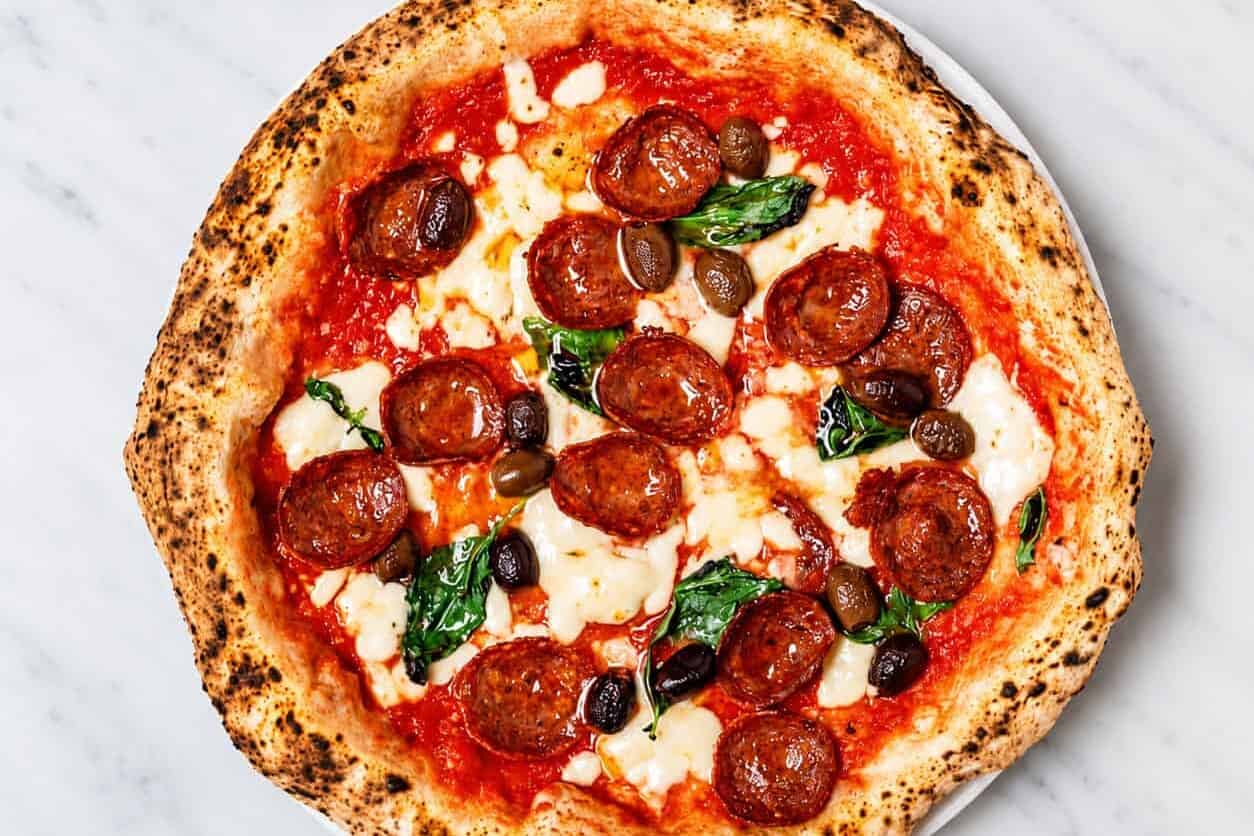
At Via Napoli Pizzeria, Sydney’s Neapolitan Pizzeria — including the Italian restaurant on Crown Street in Surry Hills and our Italian restauarant in Lane Cove — there’s one pizza that tends to announce itself before you’ve ordered it — not by its description, but by the way it arrives at a neighbouring table, the smell of crisped salami cutting through the air, the deep red of the tomato sauce and the char-edged salami against a white plate.
That pizza is the Diavola. Alongside the Margherita, it’s one of the most-ordered pizzas on the menu — and for good reason. Where the Margherita earns its reputation through restraint, the Diavola earns its place through character: bold salami, deliberate heat, and the kind of warmth that builds through a meal and stays pleasantly long after the last bite.
What Is Diavola Pizza?
Diavola pizza is a traditional Neapolitan pizza made with a tomato base, fior di latte mozzarella, and spicy salami — the single ingredient that defines it. In Italy it’s sometimes called pizza al salame piccante or simply pizza piccante, but “diavola” is the name that stuck and spread internationally.
It isn’t a modern creation or a loaded novelty. It belongs to the same family of Neapolitan pizza classics as the Margherita, the Marinara, and the Capricciosa — each built on the same wood-fired tradition, each using a short list of quality ingredients to create something unmistakable.
What “Diavola” Actually Means
Diavola is the Italian feminine of diavolo, meaning devil — a reference to the heat of the spicy salami, not extreme fire. The warmth in a well-made Diavola builds gradually through the meal: it rises in the throat, lingers pleasantly, and fades without leaving you numb.
It’s a name with character. In Neapolitan food culture, spice has always been used expressively — to punctuate, to contrast, to animate. The devil in the Diavola isn’t punishment. It’s personality.
A History of Heat in Neapolitan Cooking
Chilli has been part of southern Italian cooking since the 16th century, when New World ingredients arrived via Spain and were gradually absorbed into the cucina povera — the poor kitchen — of Naples and Campania. Unlike the north of Italy, where heat is used cautiously, the south embraced it. Chilli went into sauces, sausages, preserved meats, and eventually onto pizza.
The spicy salami that defines a Diavola — typically made from pork, seasoned with crushed chilli and spices — is part of this tradition. It didn’t arrive via a culinary trend. It grew from a regional cooking culture that has always understood how heat, fat, and acid balance each other to create something genuinely satisfying.
That tradition was formally recognised when UNESCO inscribed the art of the Neapolitan pizzaiuolo — L’Arte dei Pizzaiuoli Napoletani — on the Intangible Cultural Heritage of Humanity list in 2017. The Diavola sits squarely within that heritage.
What Goes on a Diavola?
A classic Diavola is made with hot salami, San Marzano tomatoes, fior di latte mozzarella, and Gaeta olives — each ingredient chosen for how it interacts with the others, not for volume. Neapolitan pizza doesn’t pile toppings; it edits them.
Hot Salami — Heat as a Considered Choice
Hot salami is the defining ingredient. In the wood-fired oven, the salami doesn’t simply heat through — it transforms. The fat renders, the edges curl slightly, the surface takes on a little char. Flavour intensifies and concentrates, releasing oil that mingles with the tomato sauce beneath it. Done well, it’s one of the great moments in pizza eating.
The key is quality salami with the right balance of spice and fat. Heat without depth tastes sharp and aggressive; well-made spicy salami has warmth that unfolds gradually, softened by the richness of the meat.
Gaeta Olives — Brine to Balance the Fire
Gaeta olives are a specifically southern Italian variety — small, dark, and briny, from the coastal town of Gaeta in Lazio. They appear across Neapolitan cooking precisely because their saltiness and subtle bitterness provide contrast to richer, spicier ingredients.
On a Diavola, they do exactly that. Where the salami brings heat and richness, the Gaeta olives cut through — balancing the fire, adding complexity, and keeping each bite from tipping into heaviness. They’re not there to fill space. They’re a considered flavour decision.
San Marzano Tomatoes, Fior di Latte, and Pecorino Romano
Beneath the salami and olives, the Diavola is built on Solania San Marzano tomatoes and Fior di Latte — the same foundation used across the Neapolitan menu. San Marzano tomatoes, grown in the volcanic soils of Campania under DOP (Denominazione di Origine Protetta) designation, bring natural sweetness and low acidity. Fior di Latte melts evenly and provides a creamy counterpoint to the heat. Pecorino Romano adds a salty, slightly sharp finish that lifts the whole pizza — and like every pizza from this kitchen, fresh basil and extra virgin olive oil do quiet but essential work in pulling the flavours together.
Diavola vs Margherita — Same Foundation, Different Character
Both the Diavola and the Margherita are built on the same slow-fermented Neapolitan dough and San Marzano tomato base — the difference is what sits on top, and how that single change transforms the entire eating experience.
The Margherita is the pizza of precision. Every element is stripped back, and the quality of the dough, tomato, and cheese is fully exposed. There’s nowhere to hide — which is why it’s the standard benchmark for judging a pizzeria’s skill.
The Diavola adds hot salami, and that single ingredient shifts the entire flavour conversation. The tomato’s sweetness becomes a foil for the spice. The mozzarella’s creaminess becomes essential relief. The char on the salami edges adds a smoky dimension that simply doesn’t exist on a cheese-only pizza.
Both are equally Neapolitan. They just ask different things from the ingredients — and reward different things in the eating. If the Margherita is a study in balance, the Diavola is a study in contrast.
What Makes a Great Diavola
A great Diavola is defined by what happens to the salami in the wood-fired oven: the fat renders, the edges curl and blister, and the flavour concentrates in a way that doesn’t happen in a conventional oven. Not every Diavola achieves this. The gap between an exceptional one and a mediocre one shows itself in three specific ways.
The Salami Should Curl and Blister
Flat salami sitting unchanged on a baked base is a sign of underfiring or poor placement. In a properly hot wood-fired oven, the salami heats rapidly: the fat renders, the edges curl upward, the surface blisters slightly. This is where most of the flavour development happens. If the salami looks the same coming out as it went in, something was off.
The Heat Should Build, Not Ambush
A well-made Diavola should be genuinely warm — not just faintly spiced — but the heat should unfold across the meal rather than hit hard in the first bite and numb you for the rest. That gradual build is a product of the salami’s quality and seasoning. Cheap, aggressive chilli sits on top of a pizza; good spicy salami integrates with everything around it.
The Dough Still Carries Everything
This is the part that separates a Neapolitan Diavola from every other spicy pizza. The slow-fermented dough underneath isn’t incidental — it’s load-bearing. At Via Napoli, the dough is cold-fermented for 8 hours and cooked in a wood-fired oven at 430–480°C — the temperatures set by the Associazione Verace Pizza Napoletana (AVPN), which has defined the standards for authentic Neapolitan pizza since 1984. The result is a crust with the characteristic cornicione: airy, slightly charred, and chewy enough to hold its own against the richness of the salami.
On a thick or mediocre base, the salami overwhelms. On properly fermented, wood-fired Neapolitan dough, everything finds balance: the heat, the fat, the acid, the char, the chew.
The Diavola at Via Napoli
Via Napoli Pizzeria, a Neapolitan pizza restaurant with locations in Surry Hills and the Italian restaurant on Longueville Road, Sydney, serves the Diavola with Solania San Marzano DOP tomatoes, Fior di Latte, hot salami, Gaeta black olives, Pecorino Romano, basil, and EVOO — cooked in the wood-fired oven on the same 8-hour cold-fermented dough that underpins every pizza on the menu.
Founded by Luigi Esposito, a third-generation Neapolitan pizzaiolo who grew up in Naples before bringing the craft to Sydney, Via Napoli was recognised in the Gambero Rosso Top Italian Restaurants 2026 guide — one of the highest acknowledgements available to an Italian restaurant outside of Italy.
The Diavola is available on the dine-in menu at both locations. It works particularly well alongside the Margherita: same dough, same tomato, same cheese — completely different experience on the palate. If you’ve been ordering Margheritas and want to go deeper into what Neapolitan pizza can do, the Diavola is the natural next step. Not a departure from the tradition, but a deepening of it.
Reserve your table at Via Napoli →
Frequently Asked Questions
What is diavola pizza?
Diavola pizza is a traditional Neapolitan pizza made with a tomato base, fior di latte mozzarella, and spicy hot salami. The name “diavola” means devil in Italian — a reference to the warming heat of the salami, not extreme spice. It is one of the most popular Neapolitan pizza styles alongside the Margherita and Capricciosa, and the heat comes entirely from quality spicy salami rather than added chilli flakes.
What does “diavola” mean in Italian?
Diavola is the feminine form of diavolo, meaning devil in Italian. On a pizza, the name refers to the warming heat of the spicy salami — a gradually building spice that gives the pizza its character and lingers pleasantly through the meal, rather than the aggressive heat of raw chilli.
What type of salami is used on diavola pizza?
Diavola pizza is made with hot salami — a cured pork salami seasoned with crushed chilli and spices. When cooked in a wood-fired oven, the salami renders, curls, and blisters at the edges, intensifying in flavour and releasing oil into the tomato base beneath it. At Via Napoli, the Diavola uses hot salami alongside Gaeta black olives, Pecorino Romano, and Solania San Marzano DOP tomatoes.
How spicy is diavola pizza?
Diavola pizza is genuinely warm and spicy, but the heat is designed to build gradually through the meal rather than overwhelm from the first bite. The spice comes from the quality of the salami — not added chilli flakes — which means it integrates with the other flavours rather than sitting aggressively on top. Most people who enjoy moderately spicy food find the Diavola very approachable.
What is the difference between diavola and margherita pizza?
Both the Diavola and the Margherita are classic Neapolitan pizzas built on slow-fermented dough and San Marzano tomatoes. The Margherita uses only mozzarella, tomato, and basil, keeping the focus on balance and simplicity. The Diavola adds hot salami and Gaeta olives, shifting the flavour profile to something bolder, spicier, and richer — while using the same Neapolitan dough and base ingredients underneath.
What is on the Diavola at Via Napoli?
Via Napoli’s Diavola is made with Solania San Marzano DOP tomatoes, Fior di Latte, hot salami, Gaeta black olives, Pecorino Romano, basil, and EVOO. It is cooked in a wood-fired oven on slow-fermented Neapolitan dough at 430–480°C. The Diavola is available at both the Surry Hills (628 Crown Street) and Lane Cove (141 Longueville Road) locations.
Where can I try authentic diavola pizza in Sydney?
Via Napoli Pizzeria serves the Diavola at its Surry Hills (628 Crown Street) and Lane Cove (141 Longueville Road) locations in Sydney. The pizza is made on 8-hour cold-fermented Neapolitan dough with premium imported Italian ingredients, cooked in a wood-fired oven at 430–480°C — the standard set by the Associazione Verace Pizza Napoletana (AVPN) for authentic Neapolitan pizza.

Via Napoli is Sydney’s home of authentic Neapolitan pizza, founded by Naples-born pizzaiolo Luigi Esposito. Luigi grew up in Naples helping his grandmother sell pizza fritta on the streets before training in professional kitchens and mastering the craft of traditional Neapolitan pizza-making. He brought those traditions to Sydney when he opened Via Napoli in Lane Cove in 2011 — introducing the city to properly wood-fired Neapolitan pizza: long-fermented dough, premium Italian ingredients, and high-temperature ovens that produce the soft, airy, charred crust that defines the real thing.
Now with two locations in Surry Hills and Lane Cove, Via Napoli is one of Sydney’s most-searched Italian restaurants and a Gambero Rosso Top Italian Restaurants 2026 recipient. This blog draws on over a decade of hands-on experience with Neapolitan pizza to cover the craft and culture behind what we do — from dough fermentation and regional pizza traditions to menu guides, dining occasions and the people who make it all happen.