
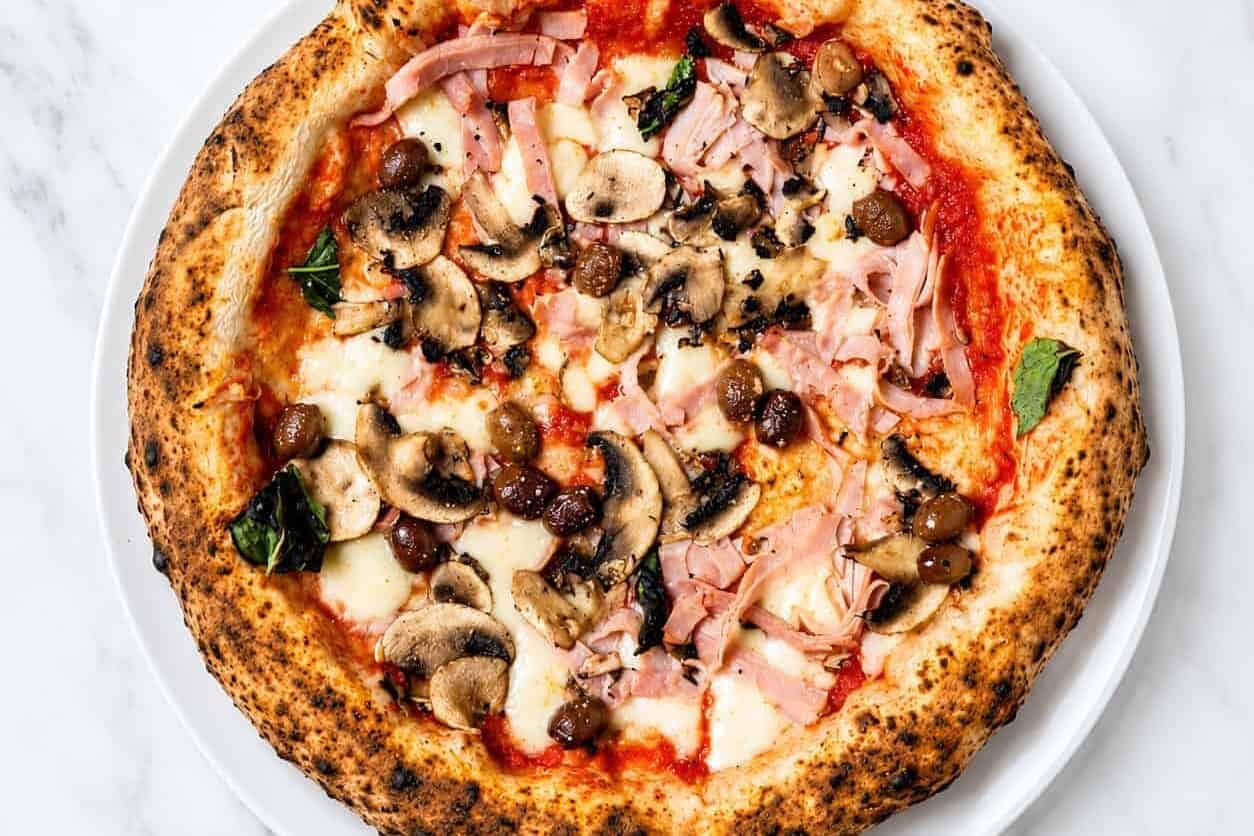
At Via Napoli, an Italian Restaurant in Sydney, the Capricciosa sits alongside the Margherita and the Diavola as one of the most-ordered pizzas in the restaurant — a reliable favourite that rarely needs selling. Via Napoli Pizzeria, a Neapolitan pizza restaurant with locations in Surry Hills and Lane Cove, Sydney, serves it at both Via Napoli, an Italian restaurant in Surry Hills and Via Napoli, an Italian restaurant in Lane Cove. Understanding what makes it work makes it a more deliberate choice, and a more satisfying one.
Of all the classic Neapolitan pizza styles, the Capricciosa is built on a specific logic: that three or four well-chosen toppings — each bringing something different to the base — can produce something more interesting than any single ingredient could alone. Not the most theatrical option on the menu, but consistently one of the most considered.
What Is Capricciosa Pizza?
Capricciosa pizza is a classic Italian pizza topped with ham, mushrooms, and olives on a tomato and mozzarella base. It is one of the foundational Neapolitan pizza styles — not as stripped back as the Margherita, not as boldly spiced as the Diavola, but with a character and logic entirely its own.
The combination isn’t arbitrary. Ham brings smokiness and substance; mushrooms bring earthiness and texture; olives bring brine and a faint bitterness. Together they create a layered flavour profile that’s greater than any single ingredient — which is exactly what the name implies.
What Does “Capricciosa” Mean?
Capricciosa is the Italian feminine of capriccioso — meaning capricious, whimsical, or according to the whim. In culinary Italian, it signals a dish made at the cook’s discretion: quality ingredients assembled according to taste rather than rigid prescription.
Applied to pizza, the name carries both a history and a philosophy. The Capricciosa emerged as a way to use quality ingredients available in any well-stocked Italian kitchen — cured meat, preserved vegetables, fungi — combined with care rather than formula. The pizza that emerged has since become one of the most consistent names in the Italian canon, even as the name still suggests a certain freedom in how it’s interpreted.
That tension between tradition and improvisation is very Italian — and very Neapolitan.
The Origins of Capricciosa Pizza
Capricciosa pizza developed in Italy across the mid-20th century, shaped by the tradition of trattorie and pizzerias offering combinations of preserved and seasonal ingredients as daily variations on the base pizza formula.
Unlike the Margherita, which has a single origin story — however much that story blurs into folklore — the Capricciosa has no founding moment. It grew from a practice: a good pizzaiolo, a set of reliable ingredients, and the question of what worked well together. By the time pizza spread internationally through Italian emigration and the post-war decades, the Capricciosa had established itself on virtually every Italian pizza menu, alongside the Margherita, Marinara, and Quattro Stagioni.
Its durability comes from the ingredients. Ham keeps, mushrooms keep, olives keep. In the hands of a good kitchen with quality versions of each, they become something genuinely worth ordering.
What Goes on a Capricciosa Pizza?
The Capricciosa’s defining ingredients are ham, mushrooms, and olives — but what those ingredients are, and how they’re treated, determines everything about the pizza that arrives at your table.
Ham — Smokiness and Substance
Ham on a Capricciosa isn’t the thin, watery deli variety. At Via Napoli, the Capricciosa uses double smoked shoulder ham — a cold-smoked cut with a deeper, more complex flavour than standard cooked ham, and one that holds its character under the heat of a wood-fired oven rather than simply steaming into blandness.
In a wood-fired bake, the ham warms through quickly, the edges take on a little colour, and the smokiness amplifies slightly as the fat heats. The result is a topping that tastes like it was made for pizza rather than transplanted from a sandwich.
Mushrooms — Earthiness at the Centre
Mushrooms do important work on a Capricciosa. Their earthy, slightly savoury quality grounds the pizza — providing a neutral richness that balances the saltiness of the ham and the brine of the olives without asserting itself loudly.
The key is preparation and quantity. Too much mushroom and the pizza turns wet; too little and the flavour doesn’t register. Mushrooms also release moisture during cooking, which means how they’re applied — and how hot the oven runs — determines whether they intensify properly or dilute the base. At extreme wood-fired temperatures, this happens fast and cleanly.
Gaeta Olives — The Southern Italian Touch
Gaeta olives are a small, dark-purple variety from the coastal town of Gaeta in Lazio, and they appear regularly across Southern Italian cooking — including on Via Napoli’s Diavola. Their flavour is briny and slightly bitter, with less of the sharp salinity of Kalamata olives and more of a clean, mineral finish.
On the Capricciosa, they provide contrast. Ham is smoky and rich; mushrooms are earthy and mild; Gaeta olives cut through both with a brightness that stops the pizza from feeling heavy. They’re small enough not to dominate the bite — present enough to register, restrained enough not to take over.
San Marzano, Fior di Latte, and the Neapolitan Base
Beneath the toppings, the Capricciosa is built on the same foundation as every pizza from this kitchen: Solania San Marzano DOP tomatoes — naturally sweet and low-acid, grown in the volcanic soils of Campania — and Fior di Latte, the fresh cow’s milk mozzarella that melts evenly and creates the clean, yielding layer that holds everything together. Fresh basil and extra virgin olive oil finish it.
The dough is cold-fermented for 8 hours, which develops the flavour and structure that a wood-fired bake then transforms. Neapolitan pizza-making as codified by the Associazione Verace Pizza Napoletana (AVPN) since 1984 — and recognised by UNESCO in 2017 as an Intangible Cultural Heritage — specifies exactly this kind of dough: unhurried, cold-fermented, built for a fast, extreme-heat bake. What arrives at the table is the product of two days of fermentation and 60-90 seconds in an oven running at 430–480°C. For a deeper look at that process, see our guide to Neapolitan pizza dough, ingredients and fermentation.
Capricciosa vs Quattro Stagioni — What’s the Difference?
Capricciosa and Quattro Stagioni share similar ingredients but are structured differently — the Quattro Stagioni divides the pizza into four distinct topping sections, while the Capricciosa combines everything across the whole base. Both often include ham, mushrooms, and olives. But where the Quattro Stagioni offers four distinct flavours in four quadrants, the Capricciosa blends them in every bite.
In practice, the ingredients overlap significantly. But the Quattro Stagioni is a pizza about separation — four distinct experiences on one base. The Capricciosa is a pizza about combination — ingredients chosen to work together rather than apart. That’s the philosophical difference, and it matters to how each pizza eats.
One further note: Via Napoli’s Capricciosa doesn’t include artichoke. That’s not an omission — it’s a reflection of the Neapolitan tradition, which places artichoke as an optional rather than defining component of the style.
What Makes a Great Capricciosa?
A great Capricciosa starts with ingredient quality and ends with oven precision — and with a short topping list, there’s nowhere for either to hide.
The Ham Should Have Real Flavour
Thin, flavourless cooked ham disappears on a Capricciosa — you can see it’s there but barely taste it. A well-made Capricciosa uses ham with enough smoking or curing to hold its own under high heat. The smokiness should be present but not overpowering; the fat should render slightly in the oven rather than sitting pale and limp.
The Mushrooms Should Intensify, Not Dilute
Waterlogged mushrooms are the Capricciosa’s most common failure point. Applied too thickly or to an oven that isn’t hot enough, mushrooms release moisture into the base, making the centre soft and the overall flavour washed out. In a properly fired wood oven, the bake is fast enough that mushrooms shrink, concentrate, and take on a savoury depth rather than releasing excess liquid. Look for mushrooms with browned edges and a firm texture — they’ve been through the heat properly.
The Base Should Still Breathe
More toppings mean more potential for a heavy, dense pizza. The reason a well-made Capricciosa stays light is the dough underneath — slow-fermented for 8 hours and baked for 60-90 seconds at 430–480°C so it stays airy rather than compressing under the weight of the toppings. The cornicione — the raised outer rim — should still carry the blistered, open texture that defines a proper Neapolitan base, even with more going on in the centre.
The Flavours Are Distinct but Coherent
You should be able to identify ham, mushroom, and olive separately — but they should also make sense together. If the olive is so aggressive it overwhelms everything, or the ham is so mild it’s invisible, the balance has broken down. The mark of a well-made Capricciosa is that every element is present and purposeful without any single ingredient dominating.
The Capricciosa at Via Napoli
Via Napoli Pizzeria — at 628 Crown Street, Surry Hills and 141 Longueville Road, Lane Cove, Sydney — serves the Capricciosa on the dine-in menu with Solania San Marzano DOP, Fior di Latte, double smoked shoulder ham, mushroom, Gaeta black olives, basil, and EVOO, cooked in the wood-fired oven on 8-hour cold-fermented Neapolitan dough. The kitchen was founded by Luigi Esposito, a third-generation Neapolitan pizzaiolo who brought these traditions from Naples to Sydney when he opened Via Napoli in Lane Cove in 2011. Via Napoli is recognised in the Gambero Rosso Top Italian Restaurants 2026 guide — one of Italian cuisine’s most respected international rankings.
Ordered alongside the Margherita, the Capricciosa shows clearly how the same Neapolitan base — dough, tomato, mozzarella — produces completely different results when the toppings change. The Margherita is about what the base can do. The Capricciosa is about what the right combination of toppings can add to it. Both are worth understanding on their own terms.
If you’ve been working your way through the classic Neapolitan menu, the Capricciosa is essential — not the most dramatic pizza on the list, but one of the most considered, and consistently one of the most satisfying.
Frequently Asked Questions
What is capricciosa pizza?
Capricciosa pizza is a classic Italian pizza topped with ham, mushrooms, and olives on a tomato and mozzarella base. It is one of the foundational Neapolitan pizza styles, alongside the Margherita and Diavola. The name means “capricious” or “whimsical” in Italian, reflecting the pizza’s origins as a combination of quality ingredients assembled according to taste rather than a fixed recipe.
What does “capricciosa” mean?
Capricciosa is the Italian feminine of capriccioso, meaning capricious, whimsical, or according to the whim. In culinary Italian, it signals a dish made at the cook’s discretion — in the case of pizza, a combination of ham, mushrooms, and olives that has since become a recognised classic in its own right.
What toppings go on a capricciosa pizza?
A traditional capricciosa pizza includes ham, mushrooms, and olives on a tomato and mozzarella base, finished with basil and extra virgin olive oil. Via Napoli’s Capricciosa uses double smoked shoulder ham, mushroom, and Gaeta black olives on Solania San Marzano DOP tomatoes and Fior di Latte, cooked in the wood-fired oven on 8-hour cold-fermented Neapolitan dough.
What is the difference between capricciosa and quattro stagioni pizza?
Both pizzas use similar ingredients — ham, mushrooms, and olives — but are structured differently. Quattro Stagioni (Four Seasons) divides the pizza into four distinct sections, each with a different topping in a separate quadrant. Capricciosa combines its ingredients across the whole pizza, letting them cook and mingle together. The flavour profiles are similar, but the eating experience differs: the Quattro Stagioni offers four distinct flavours in sequence; the Capricciosa blends them in every bite.
Is capricciosa pizza vegetarian?
No — a traditional capricciosa pizza contains ham, which is a cured meat. Via Napoli’s Capricciosa uses double smoked shoulder ham and is not vegetarian. If you are looking for a vegetarian option, the Ortolana (zucchini, eggplant, mushrooms, olives) or the Siciliana (eggplant, tomato) are good alternatives from the Via Napoli menu. Vegan cheese is also available on request.
What are Gaeta olives?
Gaeta olives are a small, dark-purple variety from the coastal town of Gaeta in Lazio, southern Italy. They have a briny, slightly bitter flavour with a clean mineral finish — less sharp than Kalamata olives. Gaeta olives appear across Southern Italian cooking and are used on the Capricciosa at Via Napoli for the contrast they provide against the richer smokiness of the ham.
Where can I try authentic capricciosa pizza in Sydney?
Via Napoli Pizzeria serves the Capricciosa at both its Surry Hills (628 Crown Street) and Lane Cove (141 Longueville Road) locations. It is available on the dine-in menu, made with 8-hour cold-fermented Neapolitan dough, Solania San Marzano DOP tomatoes, Fior di Latte, and premium Italian ingredients, cooked in a wood-fired oven at 430–480°C. Via Napoli is recognised in the Gambero Rosso Top Italian Restaurants 2026 guide.

Via Napoli is Sydney’s home of authentic Neapolitan pizza, founded by Naples-born pizzaiolo Luigi Esposito. Luigi grew up in Naples helping his grandmother sell pizza fritta on the streets before training in professional kitchens and mastering the craft of traditional Neapolitan pizza-making. He brought those traditions to Sydney when he opened Via Napoli in Lane Cove in 2011 — introducing the city to properly wood-fired Neapolitan pizza: long-fermented dough, premium Italian ingredients, and high-temperature ovens that produce the soft, airy, charred crust that defines the real thing.
Now with two locations in Surry Hills and Lane Cove, Via Napoli is one of Sydney’s most-searched Italian restaurants and a Gambero Rosso Top Italian Restaurants 2026 recipient. This blog draws on over a decade of hands-on experience with Neapolitan pizza to cover the craft and culture behind what we do — from dough fermentation and regional pizza traditions to menu guides, dining occasions and the people who make it all happen.