
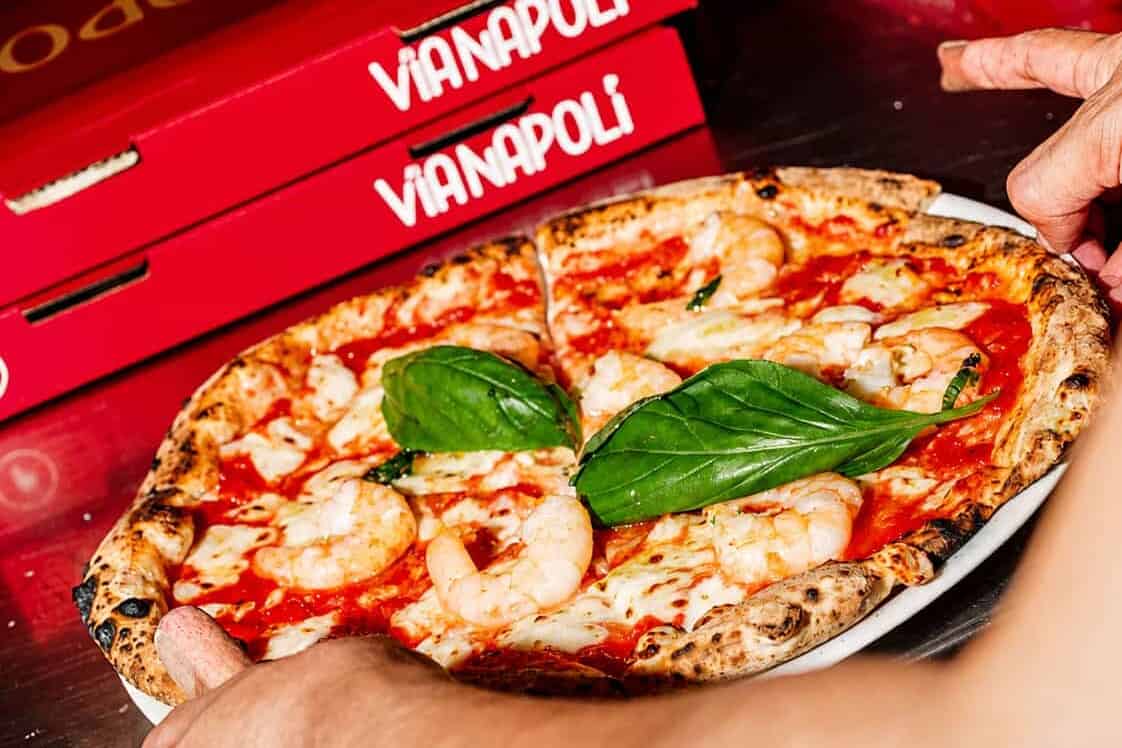
Neapolitan pizza is one of the most imitated foods on the planet, and one of the most misunderstood. At Via Napoli Pizzeria, Sydney’s Neapolitan Pizzeria, we’ve spent over a decade making it the way it’s made in Naples: naturally fermented Tipo 00 dough, a handful of exceptional Italian ingredients, and a wood-fired oven burning at 430–480°C. Here’s what actually sets it apart.
Via Napoli Pizzeria, a Neapolitan pizza restaurant with locations in Surry Hills and Lane Cove, Sydney, holds that standard at both restaurants. Whether you’re at Via Napoli, an Italian restaurant in Surry Hills or our Lane Cove pizzeria, the dough, the ingredients, and the oven don’t change.
The answer comes down to four things that must work together: the dough (Tipo 00 flour, naturally fermented for 8 hours), the ingredients (San Marzano tomatoes, fior di latte or buffalo mozzarella, olive oil, basil), the oven (wood-fired, between 430–480°C), and the cook time (60-90 seconds). Change any one of those four elements significantly, and you have something that resembles Neapolitan pizza — but isn’t.
A Pizza Born in Naples
Neapolitan pizza developed in 18th-century Naples as street food — cheap, fast, built from what was close at hand: flour, water, tomatoes, mozzarella, olive oil, basil. What began as a working-class meal became one of the most replicated dishes on the planet, and eventually received formal recognition at the highest level.
In December 2017, UNESCO added the art of the Neapolitan pizzaiuolo — the craft and cultural traditions of making Neapolitan pizza — to its Representative List of Intangible Cultural Heritage of Humanity. The European Union had already granted Neapolitan pizza Traditional Speciality Guaranteed (TSG) status in 2010, making it one of very few foods to hold protected designation at both a cultural and a commercial level. These recognitions exist because the tradition is specific, documented, and centuries old — not because anyone thought it would make a useful marketing angle.
The Rules Behind the Name
Authentic Neapolitan pizza is governed by the standards of the Associazione Verace Pizza Napoletana (AVPN), the Naples-based body whose specification forms the basis of the EU’s TSG designation. The rules are precise: the dough must be made from Tipo 00 flour, water, salt, and natural yeast only — no fat, no sugar, no additives of any kind. It must be kneaded by hand or in a low-speed mixer, hand-stretched to no more than 3–4mm in thickness, and baked in a wood-fired oven at 430–480°C for 60-90 seconds. The pizza must be served and eaten immediately on the premises — it cannot be frozen, pre-baked, or sold for later consumption.
These aren’t aspirational guidelines. They’re the technical specification that separates authentic Neapolitan pizza from everything that borrows the name and then makes compromises.
The Dough: Where It All Starts
Neapolitan dough is made from four ingredients — Tipo 00 flour, water, salt, and natural yeast — and what makes it distinctive is time. Tipo 00 is a finely milled Italian wheat flour with a medium protein content (typically 11–13.5%) that gives the dough its characteristic elasticity: it stretches paper-thin without tearing and blisters in a hot oven in a way that stiffer bread flours don’t allow. The dough then ferments naturally for 8 hours, which builds flavour from the inside out and breaks down the gluten structure in a way that faster methods cannot replicate.
The result is a thin base with a puffy, charred edge — the cornicione — airy and slightly chewy, with a flavour that holds its own before a single topping goes on. It’s nothing like the dry, rigid bases you’ll find at most pizza chains.
More on how the process works: Neapolitan pizza dough — ingredients and fermentation explained.
The Ingredients: Fewer, and Better
Authentic Neapolitan pizza uses a small, deliberate set of ingredients because each one is chosen to taste exceptional with very little else alongside it. San Marzano tomatoes, grown in the volcanic soil of the Sarno River valley south of Naples, are sweeter, less acidic, and lower in seeds than most tomato varieties. Fior di latte mozzarella (cow’s milk) or mozzarella di bufala campana (water buffalo milk) brings a richness and freshness that pre-shredded supermarket cheese cannot approach. A drizzle of cold-pressed extra virgin olive oil. A few fresh basil leaves. That’s it.
No cheese avalanche. No sauce drowning the base. A small number of things doing exactly what they’re supposed to do, in a combination refined over hundreds of years.
The Wood-Fired Oven: 430–480°C in 60-90 Seconds
The wood-fired oven is what makes Neapolitan pizza physically different from every other style — not just in flavour, but in texture and structure. At 430–480°C, the dough sets almost instantly on contact with the stone floor, trapping moisture inside while the surface develops the characteristic dark blistering — the “leopard spots” — that define a properly cooked Neapolitan base.
A conventional oven at 250°C, even fitted with a pizza stone, cannot produce this result. The pizza cooks too slowly, drying out before it can develop the right texture. Wood fire also contributes a faint smokiness that builds over hours of burning and settles into the crust in ways gas and electric heat can’t match. It’s subtle, but it changes the pizza in a way that’s hard to articulate until you’ve tasted both back to back.
More on what wood-firing actually does: what is wood-fired pizza?
The Texture: Soft, Foldable, Nothing Like You’d Expect
Neapolitan pizza is intentionally soft in the centre and foldable at the edges — not crisp, not rigid. The dough’s high hydration, the long fermentation, and the rapid 60-90 second cook time all work together to produce a base that yields when folded rather than snapping or crumbling. In Naples, this is how pizza has always been eaten: picked up, folded into quarters, consumed immediately while hot. The cornicione is airy and lightly charred at the tips, with just enough structure to hold everything together without being bready or dense.
People who try it properly for the first time often remark that it feels lighter than expected. That’s not a coincidence — it’s the direct result of how the dough is made and how briefly it cooks.
The Classics Worth Starting With
The two oldest Neapolitan pizzas are the Margherita — San Marzano tomato, fior di latte mozzarella, basil, olive oil — and the Marinara — San Marzano tomato, garlic, oregano, olive oil, no cheese. Both have been part of Neapolitan pizza tradition for more than a century. The Marinara is worth noting specifically: without cheese, the quality of the tomato and the heat of the oven have nowhere to hide. It’s a more austere pizza, and a more revealing one. At Via Napoli, that same austere spec appears on the menu as the Unesco — San Marzano, garlic, oregano, basil, olive oil, no cheese — a name that nods directly to the 2017 heritage listing.
If it’s your first time with a proper Neapolitan pizza, start with the Margherita. There’s nowhere to hide on a Margherita — every component has to earn its place. Our Diavola — tomato, mozzarella, hot Neapolitan salami — is the natural next step if you want more character, made with the same discipline. Both are on the dine-in menu, alongside the rest of the range.
Why Neapolitan Pizza Sits More Lightly
Neapolitan pizza tends to feel more digestible than heavier pizza styles because of how the dough is prepared and how briefly it cooks. The long natural 8-hour fermentation breaks down the gluten structure before baking, making the dough gentler on the stomach. The restrained toppings mean no excess oil pooling in the centre. The 60-90 second cook time prevents the base from becoming dense or greasy. The result is a pizza that feels indulgent but balanced — you can comfortably eat a whole one and still want dessert.
More on the science behind this: why Neapolitan pizza is easier to digest.
Eating Pizza the Neapolitan Way
In Naples, pizza is a sit-down meal. You order at the table, it arrives hot from the oven, and you eat it immediately. It belongs to the table — with wine or a cold Peroni, good company, and no particular hurry.
That philosophy runs through everything at Via Napoli. Luigi Esposito — our Naples-born founder, who grew up watching his grandmother sell pizza fritta on the streets of Naples before training in professional kitchens and mastering the Neapolitan craft — has never believed in making pizza any other way. It’s the same standard Gambero Rosso recognised with a Spicchio in its 2026 Top Italian Restaurants guide: quiet validation of a method that hasn’t changed. Whether you’re dining at our Surry Hills restaurant on Crown Street or our Lane Cove restaurant on Longueville Road, the pizza comes out of a wood-fired oven and lands on your table within minutes.
Neapolitan pizza makes more sense once you’ve eaten it the right way. Everything that makes it different — the soft base, the blistered crust, the clean flavour of a small number of exceptional ingredients — comes together in a way that’s easy to recognise once you’ve had the real thing.
Frequently Asked Questions
What makes Neapolitan pizza different from other pizza styles?
Neapolitan pizza is defined by four non-negotiable elements: naturally fermented dough made from finely milled Tipo 00 wheat flour, a small set of high-quality Italian ingredients (San Marzano tomatoes, fior di latte or buffalo mozzarella, extra virgin olive oil, and fresh basil), a wood-fired oven reaching 430–480°C, and a cook time of just 60-90 seconds. Together, these produce a soft, airy, blistered crust and a clean, restrained flavour that heavier pizza styles cannot replicate.
Is Neapolitan pizza always cooked in a wood-fired oven?
Authentic Neapolitan pizza must be cooked in a wood-fired oven reaching approximately 430–480°C — this is a requirement under the AVPN production standards and the EU Traditional Speciality Guaranteed (TSG) specification. The intense heat sets the dough in 60-90 seconds, creating the characteristic leopard-spot blistering, a soft interior, and a faint smokiness that no gas or electric oven at lower temperatures can replicate.
What is Tipo 00 flour and why does it matter?
Tipo 00 is a finely milled Italian wheat flour with a medium protein content — typically 11–13.5% — that gives Neapolitan dough its characteristic elasticity and extensibility. It stretches thin without tearing, blisters cleanly in a hot oven, and produces a lighter, more tender crust than higher-protein bread flours. The AVPN specification for authentic Neapolitan pizza requires this type of flour, and the dough must also be fat-free and sugar-free.
What are the official rules for authentic Neapolitan pizza?
Authentic Neapolitan pizza is governed by the Associazione Verace Pizza Napoletana (AVPN), whose standards form the basis of the EU’s Traditional Speciality Guaranteed (TSG) designation granted in 2010. The rules specify Tipo 00 flour, no fat or sugar in the dough, hand-stretching to no more than 3–4mm thickness, baking at 430–480°C in a wood-fired oven for 60-90 seconds, and immediate service on the premises — the pizza cannot be frozen or sold for later consumption.
What does UNESCO have to do with Neapolitan pizza?
In December 2017, UNESCO added the art of the Neapolitan pizzaiuolo — the craft and cultural traditions of making Neapolitan pizza — to its Representative List of Intangible Cultural Heritage of Humanity. This recognition covers the techniques, knowledge, and practices involved in Neapolitan pizza-making, not a specific recipe. Neapolitan pizza also holds EU Traditional Speciality Guaranteed (TSG) status since 2010, making it one of the few foods with both cultural heritage and commercial protected designation.
Why does Neapolitan pizza feel lighter than other styles?
Neapolitan pizza feels lighter and more digestible than heavier pizza styles because of three factors: the long natural fermentation of the dough (8 hours, which breaks down gluten structures before baking), the restrained use of toppings (no excess oil or cheese that would weigh the centre down), and the rapid 60-90 second cook time (which prevents the base from becoming dense or greasy). The result is a pizza that feels balanced rather than heavy.
What are the most traditional Neapolitan pizzas?
The two most traditional Neapolitan pizzas are the Margherita — San Marzano tomato, fior di latte mozzarella, fresh basil, and olive oil — and the Marinara — San Marzano tomato, garlic, oregano, and olive oil, with no cheese. Both have been part of Neapolitan pizza tradition for more than a century. The Margherita is the standard introduction to the style; the Marinara is arguably more revealing, because without cheese, the quality of the tomato and the oven heat do all the work.
How is Neapolitan pizza traditionally eaten?
Neapolitan pizza is traditionally eaten immediately after coming out of the oven, often folded into quarters by hand and consumed at the table. In Naples, pizza is a sit-down meal — not takeaway — and the AVPN specification explicitly states that authentic Neapolitan pizza must be served and eaten on the premises where it was made. The texture and flavour change significantly within minutes of leaving the oven; it should not be eaten cold, refrigerated, or reheated.
Can Neapolitan pizza be made in a regular home oven?
Traditional Neapolitan pizza requires a wood-fired oven at 430–480°C — a temperature no domestic oven can reach — and this is a central reason the style is so difficult to replicate at home. You can make a Neapolitan-style pizza in a regular oven using a pizza stone preheated at the oven’s maximum temperature, but the result will differ in texture, crust development, and flavour. The leopard-spot blistering and the soft, slightly steamed centre that define the authentic style require that specific combination of high heat and very fast cooking.
Can I get gluten-free Neapolitan pizza?
Traditional Neapolitan pizza uses Tipo 00 wheat flour, and the AVPN production standards do not include a gluten-free variant within the protected specification. Via Napoli offers gluten-free pizza bases as an alternative for guests with dietary requirements — the texture and structure differ from the traditional Neapolitan base, but the same approach to toppings and wood-fired cooking applies. Guests with coeliac disease or a gluten intolerance should speak with the team when booking or ordering.

Via Napoli is Sydney’s home of authentic Neapolitan pizza, founded by Naples-born pizzaiolo Luigi Esposito. Luigi grew up in Naples helping his grandmother sell pizza fritta on the streets before training in professional kitchens and mastering the craft of traditional Neapolitan pizza-making. He brought those traditions to Sydney when he opened Via Napoli in Lane Cove in 2011 — introducing the city to properly wood-fired Neapolitan pizza: long-fermented dough, premium Italian ingredients, and high-temperature ovens that produce the soft, airy, charred crust that defines the real thing.
Now with two locations in Surry Hills and Lane Cove, Via Napoli is one of Sydney’s most-searched Italian restaurants and a Gambero Rosso Top Italian Restaurants 2026 recipient. This blog draws on over a decade of hands-on experience with Neapolitan pizza to cover the craft and culture behind what we do — from dough fermentation and regional pizza traditions to menu guides, dining occasions and the people who make it all happen.