
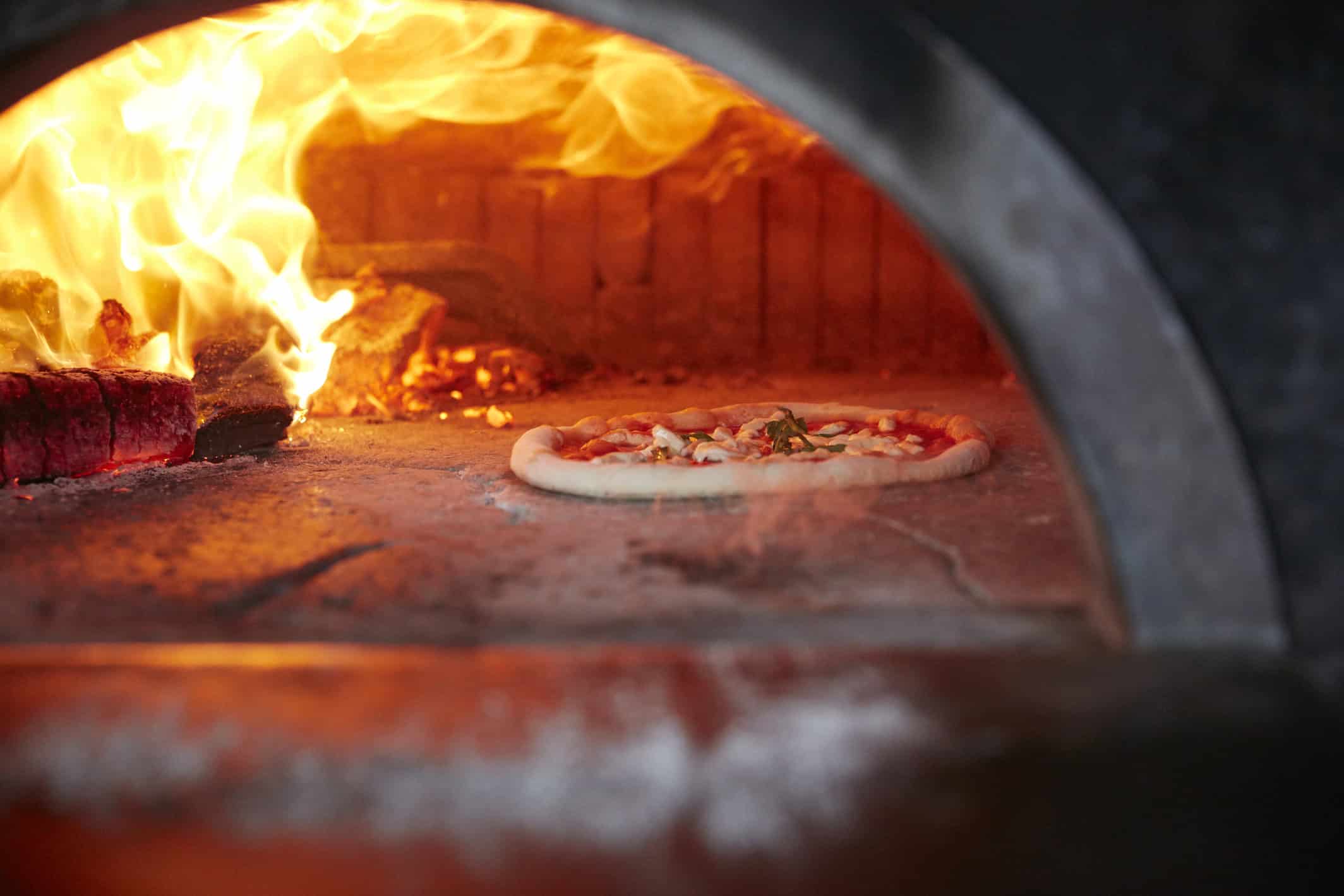
At Via Napoli Pizzeria, Sydney’s Neapolitan Pizzeria, every pizza is cooked in a wood-fired oven — because that’s not a selling point, it’s simply how Neapolitan pizza is made. But what does “wood-fired” actually mean? And why does the cooking method change everything about what ends up on your plate?
Via Napoli Pizzeria, a Neapolitan pizza restaurant with locations in Surry Hills and Lane Cove, Sydney, holds to that standard at both restaurants. Whether you’re at our Surry Hills pizzeria or the Italian restaurant on Longueville Road, the oven, the dough, and the ingredients don’t change.
What “Wood-Fired” Actually Means
Wood-fired pizza is pizza cooked in an oven heated entirely by burning wood — no gas assist, no electric element. The ovens are built from refractory stone or brick: materials that absorb heat slowly, hold it evenly, and radiate it back from every surface at once. In a traditional Neapolitan pizzeria, the cooking floor reaches 430–480°C — roughly double the maximum of most commercial gas ovens, and far beyond what any domestic oven can achieve.
At that temperature, a pizza cooks in 60-90 seconds. The fire burns at one side of the dome, and the pizzaiolo rotates each pizza by hand throughout the cook to manage heat exposure. Nothing about this process can be automated without changing what comes out.
How a Wood-Fired Oven Works
A wood-fired pizza oven produces heat through three mechanisms simultaneously: conduction from the stone floor, convection from hot air moving through the dome, and radiant heat from the dome itself. This combination is what separates it from every other cooking method — and why it produces results nothing else can replicate.
Dense hardwood, selected for its slow and consistent burn, fires the oven for two to three hours before service begins. Once the stone floor and dome reach temperature, the oven holds that heat for hours. Skilled pizzaioli manage the fire continuously throughout service, moving pizzas across different heat zones and reading the oven’s temperature by the colour of the dome and the character of the flame.
Why It Tastes So Different
Wood-fired pizza tastes different because the speed and intensity of the heat produce results a slower cook cannot. The dough surface chars lightly while the interior stays soft and open — creating the blistered, puffy rim called the cornicione that defines a proper Neapolitan pizza. Toppings stay fresh because they’re in the oven for 60-90 seconds. Cheese melts without losing its texture. The base develops flavour without becoming dry.
There’s also a subtle smokiness — a background character from the burning wood and the light charring of the crust — that no gas or electric oven can produce. It’s not a dominant flavour; it’s what gives wood-fired pizza its particular depth. There’s more on why wood-fired pizza tastes different in a dedicated breakdown.
Wood-Fired vs Conventional Oven Pizza
The gap between the two methods is bigger than most people expect — and it’s structural, not just aesthetic.
| Wood-Fired Oven | Conventional Oven |
|---|---|
| 430–480°C | 250–300°C maximum |
| 60-90 second cook | 8–15 minute cook |
| Soft, blistered cornicione | Typically drier, more uniform crust |
| Subtle smokiness from the flame | Neutral flavour profile |
| Toppings retain moisture and freshness | Moisture escapes over the longer cook |
| Traditional Neapolitan method | Modern adaptation |
In a longer, cooler bake, moisture escapes progressively from both the dough and the toppings. The crust tightens, flavours flatten, and the contrast between a lightly charred exterior and a soft, open interior disappears. Wood-fired heat moves faster than the dough can dry out — which is exactly what produces the texture that makes Neapolitan pizza what it is.
Why Wood-Fired Pizza Sits Lighter
Many people notice something after eating wood-fired Neapolitan pizza: it finishes easier and digests better than other styles. There are a few reasons for this.
Authentic Neapolitan dough is fermented for 8 hours. This extended rest breaks down complex carbohydrates and gluten structures, making the dough far more digestible than short-fermented commercial dough. The fast cook at high heat also means the base stays light and open — it never has time to become dense. Toppings are kept simple and high-quality. Nothing is heavy by design.
There’s more on the science behind this in our guide to why Neapolitan pizza is easier to digest.
The Ingredients Have to Match
At 430–480°C, there’s nowhere for a mediocre ingredient to hide. In a 12-minute conventional bake, a weaker tomato or average mozzarella has time to meld into something passable. At 60-90 seconds of intense heat, every ingredient shows exactly what it is.
Authentic wood-fired pizza is built on a short list: Italian flour milled specifically for high-heat baking, San Marzano DOP tomatoes grown in the volcanic soil of the Agro Sarnese-Nocerino zone south of Naples, fior di latte or buffalo mozzarella, and extra virgin olive oil. The simplicity is the point — high heat and quality ingredients have worked together for centuries because neither performs well without the other.
Finding Authentic Wood-Fired Pizza in Sydney
Not everything marketed as “wood-fired” uses a true wood-burning oven. Some venues run gas ovens with a token wood addition for atmosphere; others use wood ovens at lower temperatures without the skill to manage them through a full service. Authentic wood-fired pizza in the Neapolitan tradition requires the right oven, long-fermented dough, quality ingredients, and a pizzaiolo who knows how to read and manage a fire across an entire evening.
Via Napoli was recognised in the Gambero Rosso Top Italian Restaurants 2026 guide — a reflection of doing it the way it was meant to be done. Every pizza is made from dough fermented for 8 hours and cooked in imported wood-fired ovens at our Surry Hills and Lane Cove restaurants. It’s the method Luigi Esposito brought from Naples when he opened Via Napoli in 2011, and it hasn’t changed. The full range is on the dine-in menu.
The best way to understand what wood-fired cooking produces is to taste it straight from the oven — that’s what it’s made for.
Frequently Asked Questions
What is wood-fired pizza?
Wood-fired pizza is pizza cooked in an oven fuelled entirely by burning wood. The ovens are built from refractory stone or brick, designed to reach and hold temperatures of 430–480°C — far beyond any conventional oven. At that temperature, a Neapolitan pizza cooks in 60-90 seconds, producing a soft, blistered crust, fresh toppings, and a subtle smokiness that no other cooking method can replicate.
How does a wood-fired pizza oven work?
A wood-fired pizza oven works through three types of heat simultaneously: conduction from the stone floor, convection from hot air moving through the dome, and radiant heat from the dome itself. Dense hardwood burns at one side of the oven, heating the refractory stone over two to three hours before service. Once at temperature, the oven holds heat for hours. The pizzaiolo manages the fire and rotates each pizza by hand to ensure an even cook throughout the session.
Why does wood-fired pizza taste better?
Wood-fired pizza cooks at 430–480°C for 60-90 seconds — far faster and hotter than any conventional oven. That speed locks moisture into the toppings, creates a soft and blistered crust called the cornicione, and produces a subtle smokiness from the burning wood and light charring of the base. The dough also develops more complex flavour through the rapid high-heat cook. The combination of texture, freshness, and background smokiness is something a longer, cooler bake cannot replicate.
Is wood-fired pizza the same as Neapolitan pizza?
Not always. Neapolitan pizza must be cooked in a wood-fired oven — it’s a requirement of the style — but not all wood-fired pizza is Neapolitan. Authentic Neapolitan pizza also requires specific dough ingredients (Italian “00” flour, fresh yeast, water, salt), a 8-hour fermentation, and toppings such as San Marzano DOP tomatoes and fior di latte or buffalo mozzarella. The wood-fired oven is essential, but it’s one part of a broader set of requirements that define the Neapolitan tradition.
What temperature is a wood-fired pizza oven?
A traditional wood-fired pizza oven reaches 430–480°C on the cooking floor — roughly double the maximum of most commercial gas ovens, and far beyond what any domestic oven can achieve. This extreme temperature is what makes the 60-90 second cook possible, and it’s what produces the characteristic blistered cornicione and fresh, fast-cooked toppings of authentic Neapolitan pizza.
Is wood-fired pizza healthier?
Wood-fired Neapolitan pizza is not health food, but it is often lighter and easier to digest than other pizza styles. The dough is naturally fermented for 8 hours, which breaks down gluten and improves digestibility. The fast, high-heat cook keeps toppings fresh and simple. There’s no processed sauce, no heavy oil, and no dense base — which is why most people find it easier to finish without feeling weighed down compared to thicker, longer-cooked styles.
Are wood-fired pizzas carcinogenic?
The light charring on a Neapolitan pizza crust is considered safe in normal quantities. Like any charred food, the blistered spots on a wood-fired pizza contain small amounts of acrylamide — a compound produced when starchy foods cook at high heat. The amounts involved in occasional pizza consumption are well below thresholds considered harmful by food safety authorities. Authentic Neapolitan pizza aims for light blistering, not heavy charring — the goal is a soft, lightly smoky crust with a few char spots, not a burnt base throughout.
Does wood-fired pizza always taste smoky?
Not heavily. Authentic wood-fired pizza has a subtle smokiness — a background character from the burning wood and the light charring of the crust — rather than an overpowering charred flavour. The goal is balance: a blistered cornicione with a soft interior and a mild, complex flavour. Excessive charring across the pizza is usually a sign of poor temperature management, not a feature of the style.
Why do Italian pizzerias still use wood-fired ovens?
Because nothing else produces the same result. Wood-fired ovens are fundamental to Italian pizza tradition — they allow pizzaioli to cook at temperatures that create the texture, flavour, and character that define authentic Neapolitan pizza. For pizzerias making pizza the traditional way, switching to gas or electric would mean making a fundamentally different product. The oven isn’t equipment that could be swapped out; it’s the method itself.

Via Napoli is Sydney’s home of authentic Neapolitan pizza, founded by Naples-born pizzaiolo Luigi Esposito. Luigi grew up in Naples helping his grandmother sell pizza fritta on the streets before training in professional kitchens and mastering the craft of traditional Neapolitan pizza-making. He brought those traditions to Sydney when he opened Via Napoli in Lane Cove in 2011 — introducing the city to properly wood-fired Neapolitan pizza: long-fermented dough, premium Italian ingredients, and high-temperature ovens that produce the soft, airy, charred crust that defines the real thing.
Now with two locations in Surry Hills and Lane Cove, Via Napoli is one of Sydney’s most-searched Italian restaurants and a Gambero Rosso Top Italian Restaurants 2026 recipient. This blog draws on over a decade of hands-on experience with Neapolitan pizza to cover the craft and culture behind what we do — from dough fermentation and regional pizza traditions to menu guides, dining occasions and the people who make it all happen.