
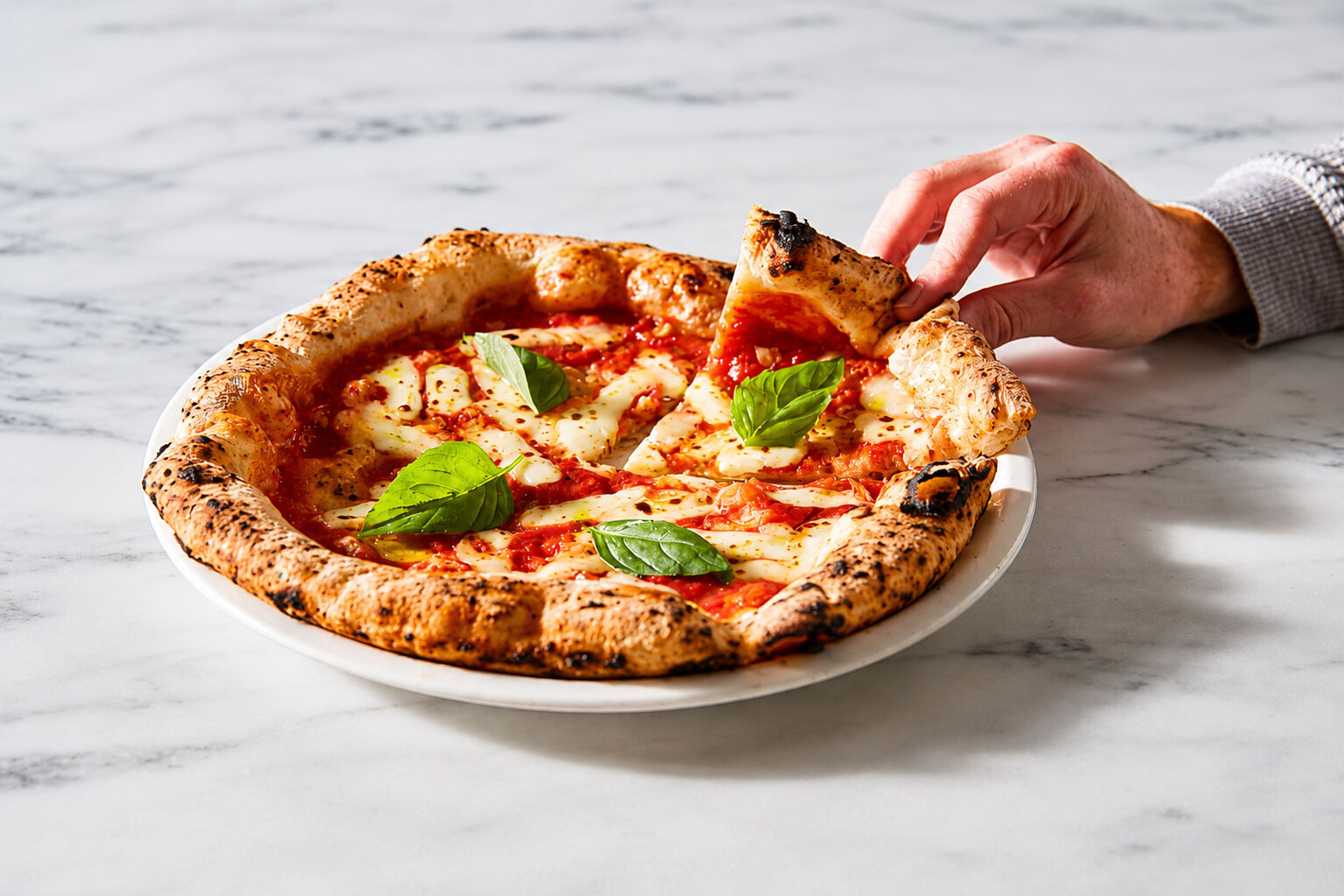
At Via Napoli Pizzeria’s Neapolitan pizza restaurant in Sydney — with restaurants in Via Napoli, an Italian restaurant in Surry Hills and our Lane Cove pizzeria — the Margherita is ordered every service and measured every service. Founder Luigi Esposito, a third-generation Neapolitan pizzaiolo, has described it the same way since he opened: it’s the pizza that tells you whether everything else in the kitchen is working.
Via Napoli Pizzeria, a Neapolitan pizza restaurant with locations in Surry Hills and Lane Cove, Sydney, holds every Margherita to that same standard.
That clarity is built into the pizza itself. No heavy toppings to hide a weak base, no richness to mask flat dough. Just slow-fermented flour, tomato, mozzarella, basil, and fire — and a result that either holds together or doesn’t. This guide covers where the Margherita came from, what each ingredient actually does, and how to recognise the real thing.
What Is a Margherita Pizza?
A Margherita pizza is a Neapolitan pizza made with crushed tomato, fresh mozzarella, basil, and extra virgin olive oil on a slow-fermented dough base, cooked at very high heat in a wood-fired oven. First prepared in Naples in 1889 for Queen Margherita of Savoy, it represents the red, white, and green of the Italian flag — and has been the benchmark of Neapolitan pizza-making ever since.
What defines a Margherita beyond its ingredients is restraint. There are no extra toppings to lean on — only the quality of the dough, the freshness of the tomato, the melt of the cheese, and the temperature of the oven. When those four things are right, the pizza balances without needing anything added. When one of them isn’t, there’s nothing to cover for it.
Born in Naples: The History of the Margherita
The Margherita pizza was born in Naples in 1889, when pizzaiolo Raffaele Esposito prepared a series of pizzas for Queen Margherita of Savoy during a royal visit to the city. The pizza made with tomato, mozzarella, and basil — the colours of the Italian flag — became her favourite, and the name followed. Whether every detail of the legend is historically certain has been debated, but what it anchors is true: the Margherita became the defining expression of Neapolitan restraint and identity.
The Associazione Verace Pizza Napoletana (AVPN), which codified Neapolitan pizza-making standards in 1984, recognises the Margherita as one of the two canonical Neapolitan pizzas — alongside the Marinara — against which everything else is measured. In 2017, UNESCO inscribed the art of the Neapolitan pizzaiuolo on its Intangible Cultural Heritage list, recognising that what a pizzaiolo does with dough, fire, and a handful of ingredients is a form of cultural knowledge worth preserving.
Why the Margherita Tests a Pizzaiolo
Among Neapolitan pizzaiolos, the Margherita is widely regarded as the truest skill test in the kitchen. Because the ingredients are so simple, every element is exposed — and nothing can compensate for what goes wrong elsewhere on the pizza.
The dough has to be properly fermented. At Via Napoli, the dough undergoes a 8-hour cold fermentation — the time that builds flavour, loosens gluten, and creates the open, airy crumb that makes the cornicione (the raised rim) light rather than bready. Compress that process and the crust tastes flat, whatever the toppings are.
The tomato has to taste alive: sweet, acidic, and genuinely of the fruit rather than cooked into something heavy. The cheese has to melt into uneven, creamy pockets rather than pooling across the surface. And the oven has to be hot enough to cook the pizza in 60-90 seconds — fast enough to keep the toppings fresh and give the crust its characteristic char. When all of that holds together, ordering the Margherita remains the cleanest way to assess what a pizzeria can actually do.
What Goes Into a Perfect Margherita Pizza
The Dough — 8 Hours Before the Oven
Neapolitan dough is flour, water, salt, and yeast. The ingredients are simple; the time is what matters. At Via Napoli, a 8-hour cold fermentation develops the flavour and structure that makes the crust light and genuinely digestible — the base holds under the sauce but stays soft through the centre, elastic enough to fold cleanly. Understanding how Neapolitan pizza dough is made is the fastest way to understand why the Margherita looks and feels the way it does.
In the oven at 430–480°C, that dough cooks fast. The crust puffs and develops the irregular dark spots — leopard spotting — that mark a genuine Neapolitan bake. The inside stays pillowy; the rim takes on the light smokiness that a domestic oven at 250°C simply cannot reach.
The Tomatoes — Solania San Marzano DOP
Tomato is the soul of a Margherita, and the best versions treat it simply. No heavy reduction, no added sugar, no cluster of herbs crowding it out. The goal is a sauce that tastes clean, slightly acidic, and genuinely of the fruit. At Via Napoli, the Margherita uses Solania San Marzano DOP tomatoes — a premium San Marzano variety grown on the volcanic plains of Campania, selected for their natural balance of sweetness and acidity. Applied lightly, they support the dough rather than saturating it.
The Mozzarella — Uneven, Creamy Patches
Cheese on a Margherita is about proportion and melt. Too much and the structure goes; too wet and the centre turns soupy. The aim is irregular, creamy pockets that settle into the tomato rather than sitting on top of it. Via Napoli’s Margherita uses Buffalo Mozzarella for its rich, yielding melt, finished with Pecorino Romano and Grana Padano DOP for a layer of savoury depth. Basil and extra virgin olive oil tie it together.
The Basil — Fragrance Before the Fork
Basil isn’t a garnish — it’s a key part of what makes a Margherita feel complete. It should smell fresh and herbal the moment the pizza reaches the table, not wilted or cooked into bitterness. A good Margherita announces itself. If you can’t smell the basil before you pick up a slice, something has gone quiet that should be present.
The Oven — 430–480°C, 60-90 Seconds
A genuine Neapolitan Margherita cooks in under two minutes. That speed is the point. At 430–480°C, the intense heat sets the base, blisters the crust, and leaves the toppings fresh rather than slowly stewing them. The flame adds a subtle smokiness that a longer, lower bake cannot reproduce — which is what makes wood-fired cooking matter for Neapolitan pizza in a way no other method can substitute.
What’s in Via Napoli’s Margherita
The Margherita is available on the full dine-in menu, in 13-inch, 50cm and one-metre sizes.
Solania San Marzano DOP · Buffalo Mozzarella · Pecorino Romano · Grana Padano DOP · basil · EVOO
Clean, comforting, and endlessly craveable — this is the one to order if you want to taste the dough, the tomato, and the fire without anything else in the way. The benchmark on every service.
How to Tell If You’re Eating a Great Margherita
A great Neapolitan Margherita shows itself clearly. The cornicione — the raised rim — should be puffy and spotted with char, soft inside rather than dry or doughy. That irregular leopard spotting across the base and crust is the signature of fast, high-heat cooking done properly.
The centre should be foldable: moist but not wet, holding together without going soggy. Tomato and cheese should sit settled into the pizza, not sliding around on the surface. Balance is what matters across the whole — bright tomato, creamy uneven cheese, basil and oil lifting the aroma without dominating it.
One thing worth knowing: authentic Neapolitan pizza is rarely perfectly round or symmetrical. It’s hand-stretched and fire-kissed, and it looks like it. A Margherita that arrives pristine, uniform, and bone-dry is probably not made the Neapolitan way.
Via Napoli Pizzeria — recognised in the Gambero Rosso Top Italian Restaurants 2026 guide — has held to that standard at Surry Hills and Lane Cove since Luigi Esposito brought these traditions from Naples. The Margherita isn’t a menu staple that gets managed. It’s the pizza that has to be right every night, because it’s the one with nowhere to hide.
Frequently Asked Questions
What is a Margherita pizza?
A Margherita pizza is a Neapolitan pizza made with crushed tomato, fresh mozzarella, basil, and extra virgin olive oil on a slow-fermented dough base, cooked at very high heat in a wood-fired oven. It was first made in Naples in 1889 by pizzaiolo Raffaele Esposito for Queen Margherita of Savoy and is considered the definitive expression of the Neapolitan pizza-making tradition.
What makes a Margherita pizza authentic?
An authentic Margherita pizza starts with slow-fermented dough — at Via Napoli, fermented for 8 hours — topped with quality crushed tomatoes, fresh mozzarella, basil, and extra virgin olive oil, then cooked in a wood-fired oven at 430–480°C. The Associazione Verace Pizza Napoletana (AVPN) codified these standards in 1984 as part of the Neapolitan pizza tradition. Each element should be minimal and high quality, with nothing added to compensate for shortcomings elsewhere.
Is Margherita pizza vegetarian?
Yes. A traditional Margherita pizza is vegetarian — it is made with tomato, mozzarella, basil, extra virgin olive oil, and salt. No meat and no fish.
Why does wood-fired cooking matter for a Margherita pizza?
Wood-fired ovens reach temperatures of 430–480°C that standard kitchen ovens cannot match. At that heat, a Neapolitan Margherita cooks in 60-90 seconds — fast enough to keep the crust airy and the toppings fresh rather than slowly stewed. The flame also adds a subtle smokiness that is part of what makes the Neapolitan Margherita taste the way it does.
How can you tell if a Margherita pizza is Neapolitan style?
A Neapolitan Margherita has a soft, foldable centre, a puffy cornicione with leopard spotting, and a base that is moist but not soggy. The tomato should taste fresh and bright, the cheese should appear as creamy, uneven pockets rather than an even layer, and the whole pizza should carry the scent of basil before you have picked up a slice. Imperfect shape is also a good sign — it means the base was hand-stretched.
Why is the Margherita considered the benchmark pizza?
Among Neapolitan pizzaiolos, the Margherita is widely regarded as the truest skill test because its simplicity leaves nowhere to hide. With only three toppings over a fermented base, the quality of the dough, the sauce, the cheese, and the bake all show up directly. If the Margherita is great, the pizzeria usually is too.

Via Napoli is Sydney’s home of authentic Neapolitan pizza, founded by Naples-born pizzaiolo Luigi Esposito. Luigi grew up in Naples helping his grandmother sell pizza fritta on the streets before training in professional kitchens and mastering the craft of traditional Neapolitan pizza-making. He brought those traditions to Sydney when he opened Via Napoli in Lane Cove in 2011 — introducing the city to properly wood-fired Neapolitan pizza: long-fermented dough, premium Italian ingredients, and high-temperature ovens that produce the soft, airy, charred crust that defines the real thing.
Now with two locations in Surry Hills and Lane Cove, Via Napoli is one of Sydney’s most-searched Italian restaurants and a Gambero Rosso Top Italian Restaurants 2026 recipient. This blog draws on over a decade of hands-on experience with Neapolitan pizza to cover the craft and culture behind what we do — from dough fermentation and regional pizza traditions to menu guides, dining occasions and the people who make it all happen.