
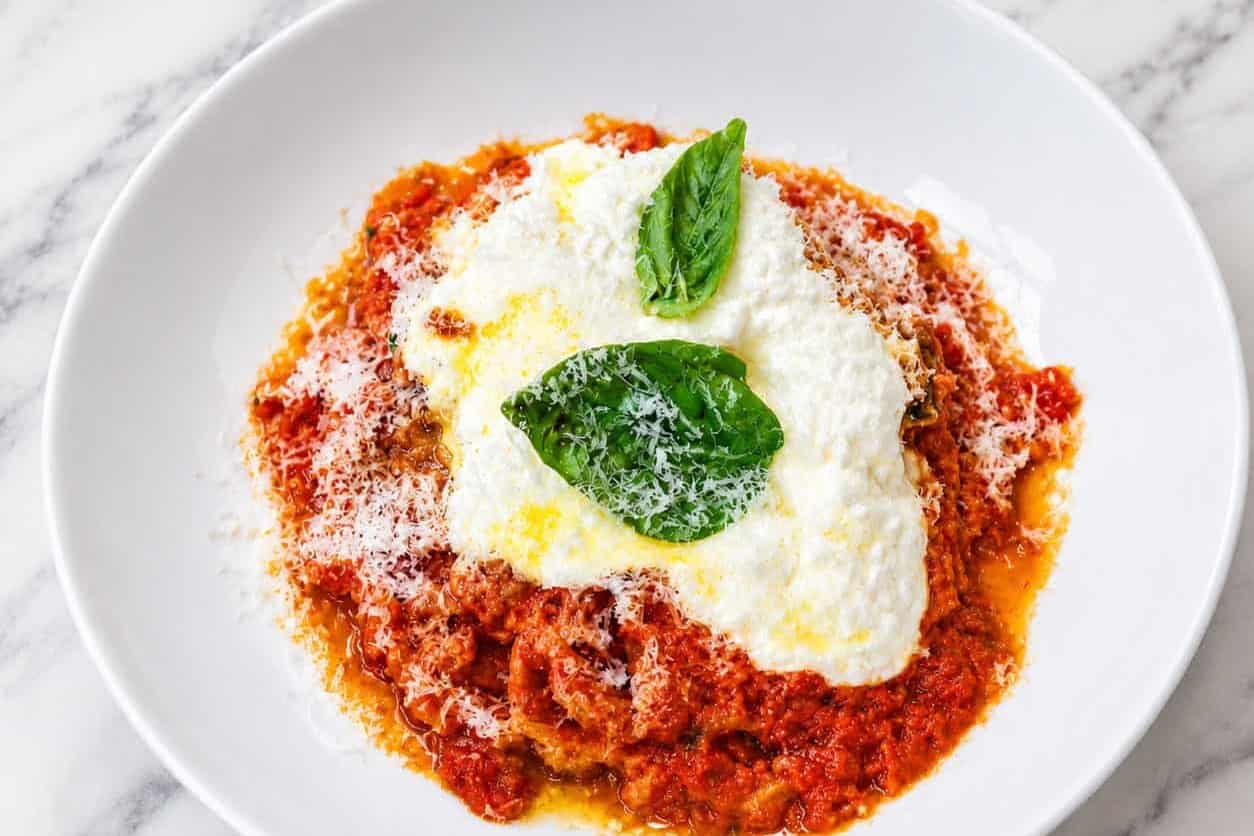
At Via Napoli, an Italian Restaurant in Sydney, San Marzano tomatoes are the foundation of almost everything on the menu that involves tomato. They go into the pizza sauce, the Zuppa di Cozze e Vongole, the Parmigiana di Melanzane, the Gnocchi Sorrentina — and the reason is straightforward: for Neapolitan cooking done properly, San Marzano is the tomato you use. That’s been true for generations, and it remains true now.
Walk into any serious Italian kitchen — a trattoria in Naples, a pizzeria in Campania, or a wood-fired restaurant anywhere in the world that takes its sourcing seriously — and you’ll find the same thing. Not necessarily fresh tomatoes. A tin. A deep-red can of whole, peeled tomatoes that, for better or worse, the rest of the tomato world is judged against.
Via Napoli Pizzeria, a Neapolitan pizza restaurant with locations in Surry Hills and Lane Cove, Sydney, was founded by Luigi Esposito — a third-generation pizzaiolo from Naples who has spent his career cooking with the same ingredients Neapolitan kitchens have relied on for decades. That’s our Surry Hills pizzeria and the Italian restaurant on Longueville Road today, both recognised in the Gambero Rosso Top Italian Restaurants 2026 guide — a guide that evaluates Italian restaurants by the rigour of their ingredients and technique. San Marzano tomatoes are central to that story. Here’s what they are, why they work, and how they appear across the menu.
What Are San Marzano Tomatoes?
San Marzano tomatoes are a variety of plum tomato grown in the Agro Nocerino-Sarnese area of Campania, in southern Italy — a fertile volcanic plain between Naples and Salerno, in the shadow of Mount Vesuvius. They are elongated, with thick walls, a small seed cavity, firm flesh, and a bright red colour that deepens as the season progresses. When processed — peeled, packed in their own juice, and sealed whole — they retain a sweetness and balance that other canned tomatoes rarely match.
They are, by most accounts, the best canned tomato in the world. That’s not marketing. It’s the consensus of Neapolitan pizza-makers, Italian chefs, and food writers who have spent decades testing alternatives and returning to the same conclusion.
What Makes San Marzano Tomatoes Different?
San Marzano tomatoes differ from standard supermarket plum tomatoes in ways that are real, measurable, and immediately apparent in the finished dish.
Sweetness Without Bitterness
San Marzano tomatoes have a natural sweetness that other varieties have to compensate for with added sugar or extended cooking. That sweetness isn’t cloying — it’s balanced by a clean acidity that keeps the flavour vivid and alive. This is the combination that makes a raw, lightly crushed San Marzano sauce taste finished even before anything is added to it.
Low Acidity and Meaty Flesh
The relatively low acidity is what makes San Marzano tomatoes so versatile in the kitchen. On pizza, a high-acid tomato fights the mozzarella and the dough; a well-balanced one supports them, allowing each element to taste like itself. The thick, meaty flesh also means the sauce cooks down to a denser, more flavourful result without becoming watery — crucial on a pizza base that needs to stay firm under extreme heat.
Fewer Seeds, Thinner Skin
San Marzano tomatoes have a smaller seed cavity and proportionally fewer seeds than most other plum varieties. Fewer seeds means less bitterness in the finished sauce, since tomato seeds contain compounds that can turn cooking acidic and sharp. The thinner skin peels cleanly during processing, which is part of why canned San Marzano tomatoes have such a smooth, even texture when crushed by hand.
The DOP Designation — and Why It Matters
The most rigorously protected San Marzano tomatoes carry the designation San Marzano dell’Agro Sarnese-Nocerino DOP — a European Protected Designation of Origin that guarantees the tomatoes were grown in the specific geographic area, from the approved variety, harvested by hand, and processed in the same region.
DOP certification exists because the San Marzano name became so sought-after that it attracted imitation. At various points, tomatoes grown in other regions — or even other countries — were labelled San Marzano without the agricultural conditions or variety that give the real ones their character. The DOP rules close that loophole, ensuring that what’s in the can is actually what the label promises.
The volcanic soil of the Agro Nocerino-Sarnese area plays a meaningful role here. Centuries of eruptions from Vesuvius have left the plains around Naples with a mineral-rich, well-draining soil that’s unusually well-suited to tomato cultivation. Whether it’s the specific minerals, the drainage, the microclimate, or some combination of all three, tomatoes grown here consistently produce fruit with a character that’s difficult to replicate elsewhere. It’s the kind of terroir argument more commonly made about wine — and in this case, the evidence is in the eating.
Solania San Marzano — Via Napoli’s Choice
Solania is a Campanian producer that has become one of the most respected names in San Marzano processing. Their tomatoes are grown in the DOP zone, and Solania has built a reputation specifically within the Neapolitan pizza world — they’re among the most widely specified San Marzano brands by serious pizzaioli in both Italy and internationally.
Via Napoli’s kitchen uses Solania San Marzano across the menu — applied with a light hand so the tomato’s natural character supports the dish rather than dominating it. On a pizza base, the sauce goes on thinly and stays fresh through the fast, high-heat bake; it shouldn’t taste cooked so much as warmed through, concentrated by the fire just enough to intensify without losing its brightness. This is the approach Luigi Esposito brought from Naples, and the one that defines how San Marzano behaves in our kitchen.
San Marzano Tomatoes Across the Via Napoli Menu
San Marzano is the most-used ingredient on our dine-in menu — it appears across more dishes than any other single component. A few worth understanding specifically:
The Pizza Base
Virtually every tomato-based pizza — the Napoletana, Diavola, Capricciosa, Siciliana, Quattro Salumi, Vesuvio, Ortolana, Allegra, and more — starts with Solania San Marzano as the base. On a pizza, the tomato has to do a specific job: provide sweetness, acidity, and flavour without making the base wet. San Marzano’s thick flesh and balanced acidity allow it to cook fast at wood-fired temperatures without releasing excess moisture into the dough.
The Margherita
The Margherita is where San Marzano tomatoes are most exposed — no complex toppings to contextualise them, just tomato, mozzarella, basil, and oil on fermented dough. If the tomato doesn’t taste right, there’s nowhere to hide. It’s the simplest, most direct test on the menu of whether the tomato is doing its job.
Zuppa di Cozze e Vongole and the Antipasti
Outside pizza, San Marzano tomatoes play a different role. In the Zuppa di Cozze e Vongole — mussels and vongole simmered with garlic and chilli — they form the base of the broth, their low acidity letting the shellfish’s brine come through without turning sharp or bitter. In the Parmigiana di Melanzane, they’re the tomato sauce that binds each layer of fried eggplant and buffalo mozzarella together. If you’ve explored our antipasto dishes, you’ve already experienced what San Marzano does at a gentler simmer rather than the fast blast of the pizza oven.
Gnocchi Sorrentina
The Gnocchi Sorrentina — homemade gnocchi, San Marzano tomatoes, melted buffalo mozzarella, Grana Padano DOP, basil, and extra virgin olive oil — is the simplest demonstration of what San Marzano contributes in a pasta dish. The sauce has to stay bright and fresh-tasting even after cooking through with the gnocchi. A watery or acidic tomato would turn heavy; a San Marzano stays lively and balanced, which is why it’s the standard for Sorrentina dishes across southern Italy.
San Marzano Tomatoes and the Wood-Fired Oven
San Marzano tomatoes perform better than any other variety in a wood-fired oven because they arrive at the dough already flavour-complete — and a 60-90 second bake at 430–480°C is not enough time to develop an inferior tomato into something worth eating.
The sauce goes on crushed or lightly broken rather than fully cooked down, and the brief time in the oven is enough to warm and concentrate it without cooking out the brightness that makes it worth using. The result is a tomato that tastes simultaneously fresh and cooked — vivid but not raw, complex but not heavy. Getting that balance with a lesser tomato is substantially harder.
There’s a practical reason Neapolitan pizza evolved specifically around San Marzano rather than any other variety: the low moisture prevents the base from becoming soggy, the natural sweetness balances the mozzarella and dough, and the low acidity means the sauce tastes fresh even after an extreme-heat bake. The tradition and the ingredient developed together. Neapolitan pizza didn’t settle on San Marzano arbitrarily — it settled on San Marzano because the tomato fits the method better than anything else does.
Frequently Asked Questions
What are San Marzano tomatoes?
San Marzano tomatoes are a variety of plum tomato grown in the Agro Nocerino-Sarnese area of Campania, southern Italy — a volcanic plain between Naples and Salerno, in the shadow of Mount Vesuvius. They are elongated with thick, meaty flesh, a small seed cavity, and a natural sweetness balanced by low acidity. The most rigorously certified versions carry the San Marzano dell’Agro Sarnese-Nocerino DOP designation, which guarantees their geographic origin, approved variety, and processing method.
What makes San Marzano tomatoes different from regular tomatoes?
San Marzano tomatoes have a higher natural sweetness, lower acidity, thicker flesh, and fewer seeds than standard plum tomatoes. This produces a smoother, less bitter sauce that doesn’t need added sugar or extended cooking to taste balanced. The volcanic soil of the Campania region — enriched by centuries of eruptions from Mount Vesuvius — is credited with giving the tomatoes their distinctive mineral character and depth.
Are San Marzano tomatoes DOP protected?
Yes. San Marzano dell’Agro Sarnese-Nocerino DOP is a European Protected Designation of Origin that requires the tomatoes to be grown in a specific geographic area of Campania, from the approved variety, harvested by hand, and processed in the same region. DOP certification was introduced because the San Marzano name was widely imitated by growers outside the original area — the certification ensures the label accurately reflects what’s in the can.
What is Solania San Marzano?
Solania is a Campanian producer specialising in DOP San Marzano tomatoes, widely regarded in the Neapolitan pizza world as one of the finest producers of the variety. Via Napoli Pizzeria uses Solania San Marzano across the menu — as the base for most pizza sauces, in antipasti dishes such as the Zuppa di Cozze e Vongole, and in pasta preparations including the Gnocchi Sorrentina.
Why do pizza restaurants use San Marzano tomatoes?
San Marzano tomatoes perform exceptionally well in wood-fired pizza because their low moisture content prevents the base from becoming soggy, their natural sweetness balances the mozzarella and dough, and their low acidity means the sauce tastes fresh even after a fast, high-temperature bake at 430–480°C in 60-90 seconds. They are the traditional choice for Neapolitan pizza and remain the standard that serious pizzerias measure other tomatoes against.
Are San Marzano tomatoes worth it?
For Neapolitan cooking, San Marzano tomatoes are not a premium upgrade — they are the correct ingredient. The difference between a San Marzano sauce and one made from standard plum tomatoes is apparent in the finished dish: the balance is cleaner, the flavour brighter, and the texture more consistent. In applications where the tomato is most exposed — such as a Margherita pizza with no competing toppings — there is no comparable substitute.
Are San Marzano tomatoes available in Australia?
Yes — DOP San Marzano tomatoes, including Solania, are available in Australia through specialty Italian food suppliers and some independent grocers. They are generally sold as whole, peeled tomatoes in tins. Not all products labelled “San Marzano” in Australian supermarkets carry the DOP designation — the DOP mark on the label is the reliable indicator of certified origin and variety.
Where can I taste San Marzano tomatoes in Sydney?
Via Napoli Pizzeria uses Solania San Marzano tomatoes across the menu at both its Surry Hills (628 Crown Street) and Lane Cove (141 Longueville Road) locations. They appear in most tomato-based pizzas, the Zuppa di Cozze e Vongole, Parmigiana di Melanzane, Gnocchi Sorrentina, and several other dishes on the dine-in menu.

Via Napoli is Sydney’s home of authentic Neapolitan pizza, founded by Naples-born pizzaiolo Luigi Esposito. Luigi grew up in Naples helping his grandmother sell pizza fritta on the streets before training in professional kitchens and mastering the craft of traditional Neapolitan pizza-making. He brought those traditions to Sydney when he opened Via Napoli in Lane Cove in 2011 — introducing the city to properly wood-fired Neapolitan pizza: long-fermented dough, premium Italian ingredients, and high-temperature ovens that produce the soft, airy, charred crust that defines the real thing.
Now with two locations in Surry Hills and Lane Cove, Via Napoli is one of Sydney’s most-searched Italian restaurants and a Gambero Rosso Top Italian Restaurants 2026 recipient. This blog draws on over a decade of hands-on experience with Neapolitan pizza to cover the craft and culture behind what we do — from dough fermentation and regional pizza traditions to menu guides, dining occasions and the people who make it all happen.