
At Via Napoli Pizzeria’s Neapolitan pizza restaurant in Sydney, the question we’re asked most often isn’t “what should I order?” It’s “what actually makes a pizza the best?”
Via Napoli Pizzeria, a Neapolitan pizza restaurant with locations in Surry Hills and Lane Cove, Sydney, was built around one answer. Founder Luigi Esposito — a Naples-born, third-generation pizzaiolo — brought his family’s standards to Australia in 2011. Not to reinvent Neapolitan pizza, but to make it properly: 8-hour cold-fermented dough, Solania San Marzano DOP tomatoes, and wood-fired ovens running at 430–480°C. That foundation means we can speak to what “best” actually requires — not as a claim, but as a worked standard.
Here’s what to look for.
What “Best” Actually Means for Pizza
The best pizza in Sydney is consistently good, not occasionally great. That sounds obvious, but it rules out a surprising number of contenders — places that produce an extraordinary pizza on a good night but can’t sustain it. Consistency is the first filter, and it’s the hardest one to pass.
Beyond that, “best” depends on style. Sydney’s pizza scene covers Neapolitan, Roman, New York, Detroit, and various creative hybrids. Each has its own logic and its own benchmarks. A wood-fired Neapolitan and a square long-proved Roman are answering different questions — comparing them directly misses the point.
What holds across all styles: the dough was given time, the ingredients were chosen for flavour not appearance, the cooking method matched the style, and the result repeats reliably. If all four are in place, you’re in strong territory. If one is missing, you’ll feel it — even if you can’t name the reason.
Start With the Dough — It’s the Only Test That Matters
Dough is the foundation that no topping can rescue. A poorly fermented base produces a pizza that eats dense and heavy — and no quantity of premium ingredients on top will fix it.
For Neapolitan pizza, the standard is a 8-hour cold fermentation using finely milled Tipo 00 flour, with no fat and no sugar in the dough. That fermentation window lets the gluten develop slowly, producing a base that is elastic, airy, and flavourful before it ever meets a topping. The extended process also breaks down starches in ways that make the finished pizza lighter and easier to digest — which is why a properly made Neapolitan pizza rarely leaves you feeling heavy.
The practical test is simple. Order the plainest pizza on the menu and pay attention to the crust. Is it airy with a slight chew, or just dense bread? Does the crust itself have flavour, or does it taste like nothing? A base that passes this test will carry everything else. One that doesn’t won’t be saved by what’s on top of it.
At Via Napoli, the dough ferments for 8 hours at both Via Napoli Pizzeria Surry Hills and our Lane Cove pizzeria. The process is the same at both locations, not approximate.
The Wood-Fired Standard — and Why Temperature Is the Point
A Neapolitan wood-fired oven runs at 430–480°C. At that temperature, a pizza bakes in 60-90 seconds. That isn’t just a timing choice — it’s the mechanism that creates the result.
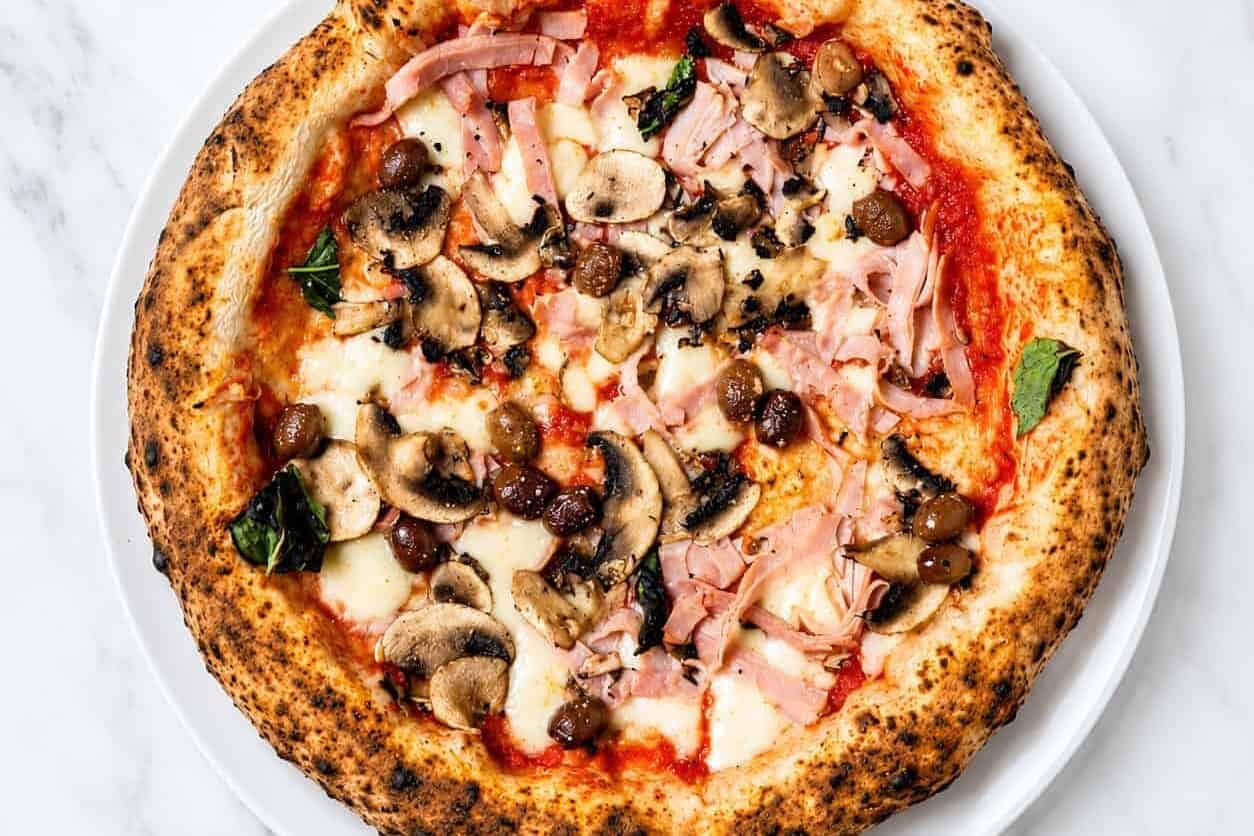
The intense radiant heat blisters and lightly chars the crust while keeping the interior soft and moist. The toppings cook without overcooking: a San Marzano tomato base stays bright and slightly acidic, fior di latte mozzarella melts cleanly without turning greasy, fresh basil wilts just enough. Because everything finishes in under two minutes, each ingredient retains its own character rather than collapsing into a single uniform layer.
A gas oven at 250°C, running a pizza for ten minutes, produces a fundamentally different result — not a lesser version of the same thing, but a different thing entirely. The full explanation of what’s actually happening at 430–480°C is covered in this article on why wood-fired pizza tastes better. The short version: the speed is the mechanism, and you can’t replicate it at lower temperatures.
Ingredients: The Fewer, the More They Matter
The simplest pizzas are the most revealing. A Margherita — tomato, mozzarella, basil, olive oil — has nowhere to hide. Every component has to earn its place, because there’s nothing else doing any of the work.
At Via Napoli, the tomato base uses Solania San Marzano DOP tomatoes, grown in the Agro Sarnese-Nocerino region of Campania — the only zone in Italy where the San Marzano DOP designation applies. They’re naturally lower in acidity and higher in natural sweetness than standard tomato varieties, which means the sauce needs nothing added: no sugar, no extra seasoning. The cheese is fior di latte — fresh cow’s milk mozzarella — chosen for its clean flavour and the way it behaves under the heat of a wood-fired oven.
The test holds at any pizzeria: order simple, evaluate honestly. If the Margherita is excellent on its own, the kitchen understands its ingredients. If it needs six toppings to be interesting, that’s the ingredients telling you something.
The Neapolitan Specification: Why There’s an Actual Standard
Neapolitan pizza isn’t just a style — it’s a protected method. In 2010, the European Union granted Neapolitan pizza Traditional Speciality Guaranteed (TSG) status, establishing formal requirements for dough composition, fermentation, topping application, and cooking conditions. UNESCO added the craft of Neapolitan pizzaiolo to the Intangible Cultural Heritage of Humanity list in 2017.
The Associazione Verace Pizza Napoletana (AVPN), founded in Naples in 1984, maintains the full technical specification. The requirements include Tipo 00 flour, water, salt, and yeast — no fat, no sugar — with a minimum proving time, a maximum base thickness of 3–4mm at the centre, and baking in a wood-fired oven at not less than 430–480°C.
This matters for Sydney diners because it means there’s a verifiable standard against which Neapolitan pizza can actually be measured. It’s not a matter of opinion. For a full breakdown of what that standard requires and how it differs from other pizza styles, this article on what makes Neapolitan pizza different covers it in detail.
How to Choose the Best Pizza for Your Occasion
The best pizza for a long Saturday lunch is different from the best pizza for a Wednesday night takeaway. Matching the experience to the occasion matters as much as the pizza itself.
For the full Neapolitan picture — wood-fired pizza straight from the oven, a proper Italian wine list, pasta, antipasti, the atmosphere that makes a meal feel unhurried — dine-in at either Via Napoli location gives you that. Both venues also offer set menus for larger groups and celebrations, which removes the guesswork from group ordering. For a one-on-one recommendation rather than a group booking, a Via Napoli gift card lets the other person choose their own night.
For takeaway, timing is the main variable most people underestimate. A wood-fired Neapolitan pizza has a short freshness window. The difference between a pizza collected immediately after it comes out of the oven and one that’s sat for thirty minutes is noticeable — not just in temperature, but in texture. Order when you’re ready to collect.
If you already know what you’re after, our most-ordered pizzas are a good place to start. For the full breakdown of dine-in versus takeaway — and everything else pizza in Sydney covers — see our Sydney pizza guide.
Via Napoli Pizzeria: Two Sydney Locations, the Same Standard
Via Napoli Pizzeria was founded by Luigi Esposito in 2011, at 141 Longueville Road, Lane Cove NSW 2066 — a neighbourhood institution on Sydney’s North Shore that has been serving the same community for over fifteen years. Luigi grew up in Naples helping his grandmother sell pizza fritta on the streets of the city before training in professional kitchens and sharpening his craft over decades. He brought those techniques to Sydney with one intention: to make Neapolitan pizza the way it’s supposed to be made.
A second location opened at 628 Crown Street, Surry Hills NSW 2010 — inner-city dining suited to weeknight dinners, date nights, and meals in one of Sydney’s most food-forward neighbourhoods. In 2026, both locations were recognised in the Gambero Rosso Top Italian Restaurants guide — the Italian food authority that evaluates authentic Italian restaurants internationally. The Surry Hills location also holds the Outstanding Restaurant award from the Local Business Awards. Both recognitions are a product of consistency, not novelty.
Both locations run the same wood-fired ovens, use the same ingredients, and follow the same dough process. The pizza is the same across both. The neighbourhood is the choice.
Frequently Asked Questions
What makes the best pizza in Sydney?
The best pizza in Sydney consistently combines long-fermented dough, quality ingredients, and a cooking method matched to the style. For Neapolitan pizza specifically, the standard requires Tipo 00 flour, a minimum 8-hour cold fermentation, named Italian ingredients such as San Marzano DOP tomatoes and fior di latte mozzarella, and a wood-fired oven operating at not less than 430–480°C. When those elements are all in place, the result is a pizza that is light, flavourful, and easy to digest.
How can I tell if a pizzeria is using good ingredients?
Order the simplest pizza on the menu — a Margherita or a Marinara — and evaluate it without embellishment. A well-made Margherita using genuine San Marzano DOP tomatoes and quality fior di latte mozzarella does not need enhancement to be excellent. If the tomato base is bright and balanced, and the cheese melts cleanly without pooling oil, the ingredients are doing their job. If the pizza needs several extra toppings to be interesting, that usually signals weaker base ingredients.
Does Via Napoli Pizzeria use a wood-fired oven?
Yes. Both Via Napoli Pizzeria locations — at 628 Crown Street, Surry Hills NSW 2010 and 141 Longueville Road, Lane Cove NSW 2066 — cook pizza in wood-fired ovens that reach 430–480°C. At that temperature, a Neapolitan pizza bakes in 60-90 seconds, producing the blistered, lightly charred crust and soft centre that define the style. Wood-fired cooking is central to Via Napoli’s method, not a marketing addition.
What pizza should I try first if I haven’t had Neapolitan pizza before?
Start with a Margherita. With only three or four components — San Marzano tomato, fior di latte mozzarella, fresh basil, and extra virgin olive oil — a Margherita is the clearest test of what a pizzeria can do. If the dough is light, the crust has structure and flavour, and the sauce is balanced without added sugar or seasoning, the fundamentals are in place. It is the pizza most closely associated with Neapolitan tradition and the most honest test of a kitchen’s standards.
Is Neapolitan pizza easier to digest than other styles?
A well-made Neapolitan pizza — using long cold-fermented dough and high-heat cooking — is generally lighter and easier to digest than pizza made with a quickly-proved base. The extended fermentation process breaks down gluten and starches over time, producing a dough that is both more flavourful and gentler on digestion. This is one reason a properly made Neapolitan pizza rarely produces the heavy feeling that can follow a rushed or commercially produced base.
Where are Via Napoli Pizzeria’s Sydney locations?
Via Napoli Pizzeria has two Sydney locations: 628 Crown Street, Surry Hills NSW 2010 and 141 Longueville Road, Lane Cove NSW 2066. Both offer dine-in, takeaway, and online ordering. Current opening hours for each location are listed on the Surry Hills and Lane Cove location pages at vianapoli.com.au.

Via Napoli is Sydney’s home of authentic Neapolitan pizza, founded by Naples-born pizzaiolo Luigi Esposito. Luigi grew up in Naples helping his grandmother sell pizza fritta on the streets before training in professional kitchens and mastering the craft of traditional Neapolitan pizza-making. He brought those traditions to Sydney when he opened Via Napoli in Lane Cove in 2011 — introducing the city to properly wood-fired Neapolitan pizza: long-fermented dough, premium Italian ingredients, and high-temperature ovens that produce the soft, airy, charred crust that defines the real thing.
Now with two locations in Surry Hills and Lane Cove, Via Napoli is one of Sydney’s most-searched Italian restaurants and a Gambero Rosso Top Italian Restaurants 2026 recipient. This blog draws on over a decade of hands-on experience with Neapolitan pizza to cover the craft and culture behind what we do — from dough fermentation and regional pizza traditions to menu guides, dining occasions and the people who make it all happen.