
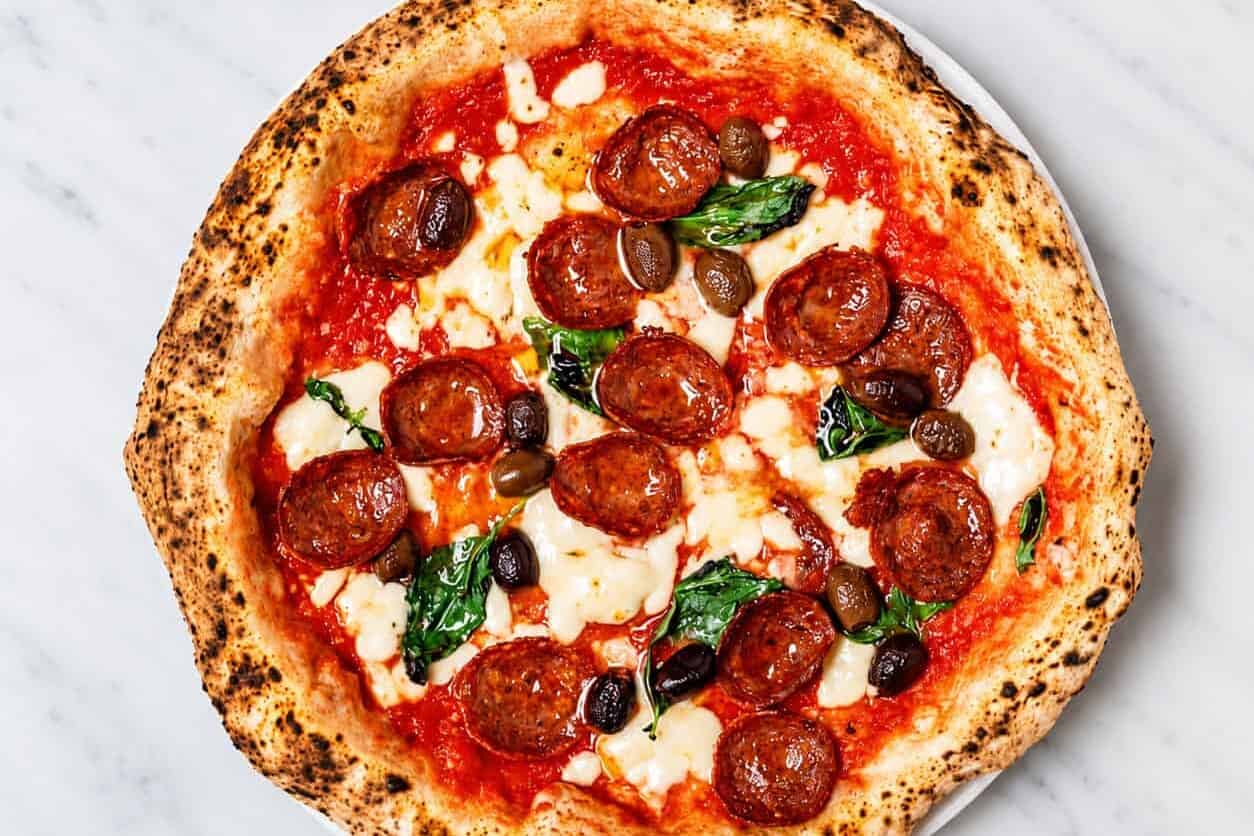
At Via Napoli, an Italian Restaurant in Sydney, the heat on a Diavola comes from hot Neapolitan salami — sliced, laid on the dough, and left to blister and curl in the wood-fired oven. It’s a different ingredient entirely from the one most people mean when they ask about “spicy Italian salami” online: nduja. The two get confused constantly, which is understandable, because they do similar work in a dish. But they come from different regions, different traditions, and different textures on the plate.
What Is Nduja?
Nduja (pronounced en-DOO-ya) is a spreadable, fermented pork sausage from Calabria, in the southern toe of Italy, made from pork shoulder and belly fat, a high proportion of Calabrian chillies, and salt. Unlike most cured salami, which firms up as it ages, nduja stays soft enough to spread with a knife — the result of its very high fat content combined with the chilli, which acts as both flavour and preservative.
It’s sold in a casing, like a salami, but that’s where the resemblance ends. Cut into a firm salami and you get slices. Cut into nduja and you get something closer to a chilli-red paste, ready to be spread on bread, stirred into a sauce, or melted through a hot dish.
Where Nduja Comes From
Nduja originates from Spilinga, a small town in Calabria, the mountainous, chilli-growing region that forms the toe of the Italian boot. It belongs to the tradition of cucina povera — peasant cooking built on using every part of the animal and preserving it through the winter months. Calabrian farmers combined the fattier cuts of pork, which wealthier households didn’t want, with the region’s abundant chillies. The chilli wasn’t just flavour — in large enough quantities, it helped preserve the meat without smoking or long air-drying.
That history explains why nduja tastes the way it does: not sharp or vinegary like many cured meats, but rich, fatty, and slow-building in heat, with the chilli’s warmth carried by the fat rather than sitting on top of it.
Nduja vs Hot Salami — What’s the Difference?
The main difference between nduja and hot salami is texture and origin: nduja is a soft, spreadable Calabrian paste, while hot salami — the kind used on a Neapolitan Diavola — is a firm, sliceable cured meat from Campania, the region around Naples. They’re both spicy pork products from southern Italy, which is why they’re so often mixed up, but a Neapolitan pizzaiolo would never call them interchangeable.
Traditional Neapolitan pizza doesn’t use nduja. The Diavola, the classic spicy pizza of Naples, is built on hot salami that’s sliced and cooked whole, so it curls, chars slightly at the edges, and releases its fat directly into the tomato and cheese beneath it. Nduja, being a paste, behaves completely differently under heat — it melts and spreads across the surface rather than holding its shape. Some pizzerias outside Naples use it for exactly that reason, dotting it over a base before baking for a different kind of heat. It’s a legitimate ingredient with its own regional pedigree — just not part of the Neapolitan tradition that governs how a Diavola is made.
This is also why you won’t find nduja on the menu at Via Napoli Pizzeria, a Neapolitan pizza restaurant with locations in Surry Hills and Lane Cove, Sydney. The same Neapolitan repertoire applies at both Via Napoli Pizzeria Surry Hills and Via Napoli, an Italian restaurant in Lane Cove, where the Diavola’s heat comes from hot salami, not Calabrian nduja — a distinction that matters if you’re trying to understand what makes a pizza genuinely Neapolitan rather than broadly “Italian and spicy.”
What’s Actually In Nduja
A traditional nduja is built from three core ingredients: pork (typically shoulder and belly, chosen for their fat content), Calabrian chillies — often a blend that includes the small, intensely hot diavolicchio variety — and salt. The mixture is ground finely, packed into a natural casing, and left to ferment and age for several months. That ageing process is what develops the deep red colour and the rounded, slow-building heat that distinguishes good nduja from something that’s simply been mixed with chilli flakes.
The ratio of fat to chilli is what makes nduja spreadable rather than sliceable. Most cured salami loses moisture and firms up as it dries; nduja’s high fat content means it never fully hardens, even after months of ageing. That’s a deliberate outcome of the recipe, not a sign of an underdone cure.
How Nduja Is Used
Nduja’s versatility is part of why it’s become well known outside Calabria. Because it’s already soft, it doesn’t need to be cooked to be eaten — spread thinly on warm bread or bruschetta, it melts slightly from the heat of the toast and releases its fat and chilli oil. Stirred into a tomato sauce, a small spoonful is usually enough to change the character of an entire dish, adding smokiness, depth, and heat without needing extra seasoning. It’s also used to finish seafood, particularly prawns or mussels, where its fat carries the chilli through the dish.
The common thread across all of these uses is restraint. Because nduja is concentrated and fatty, a little goes a long way — treating it like a condiment rather than a main ingredient is how it’s traditionally used in Calabrian kitchens.
Is Nduja the Same as Chorizo?
Nduja and chorizo are often compared because both are spicy, cured pork products, but they’re made differently and taste different. Chorizo, from Spain, is typically smoked and firm, with paprika providing its colour and heat. Nduja is unsmoked, unfired, and left soft through its high fat content — its heat comes from fresh Calabrian chilli rather than dried paprika, and its texture is closer to a paste than a sausage you’d slice.
Nduja and the Neapolitan Tradition
Understanding nduja is a useful way to understand why regional specificity matters so much in Italian food. Naples and Calabria are both in southern Italy, both use chilli generously, and both sit within a food culture built on cucina povera principles — but they produce genuinely different ingredients with different histories. The Neapolitan pizzaiuolo tradition, recognised by UNESCO in 2017 as part of the Intangible Cultural Heritage of Humanity, is specific about what belongs on a Neapolitan pizza and what doesn’t. Hot salami belongs. Nduja, for all its merit, is a Calabrian ingredient with its own story — one that deserves to be told accurately rather than folded into “spicy Italian sausage” as a catch-all.
That’s the same standard applied across the dine-in menu at Via Napoli: ingredients chosen because they belong to the Neapolitan tradition the kitchen is built on, not because they’re broadly Italian or currently popular. If nduja is what you’re after, it’s worth seeking out a Calabrian specialist. If you want to taste how Naples does heat, the Diavola is the place to start.
Frequently Asked Questions
What is nduja?
Nduja is a spreadable, fermented pork sausage from Calabria in southern Italy, made from pork shoulder and belly fat, Calabrian chillies, and salt. Its high fat content keeps it soft enough to spread even after months of ageing, unlike most firm, sliceable salami.
How do you pronounce nduja?
Nduja is pronounced en-DOO-ya. The initial “n” is soft, almost silent, which is why it’s sometimes written as ‘nduja with an apostrophe to signal the dropped vowel sound at the start of the word.
Is nduja the same as hot salami?
No. Nduja is a soft, spreadable Calabrian paste, while hot salami is a firm, sliceable cured meat from Campania, the region around Naples. Traditional Neapolitan pizza, including the Diavola, is made with hot salami rather than nduja.
Does Via Napoli use nduja on its pizzas?
No. Via Napoli’s Diavola pizza uses hot Neapolitan salami, which is sliced and cooked whole in the wood-fired oven, rather than nduja, which is a Calabrian ingredient outside the traditional Neapolitan pizza repertoire.
What does nduja taste like?
Nduja has a rich, fatty flavour with a slow-building chilli heat, rather than a sharp or vinegary taste common in other cured meats. The fat content carries the chilli’s warmth evenly through the mouth instead of concentrating it in one hit.
Is nduja the same as chorizo?
No. Chorizo is a Spanish sausage that’s typically smoked and firm, with paprika providing its colour and heat. Nduja is unsmoked and stays soft due to its high fat content, with heat coming from fresh Calabrian chilli rather than dried paprika.
How is nduja traditionally eaten?
Nduja is traditionally spread on warm bread or bruschetta, stirred into tomato-based pasta sauces in small amounts, or used to finish seafood dishes such as prawns or mussels. A little goes a long way given its concentrated fat and chilli content.

Via Napoli is Sydney’s home of authentic Neapolitan pizza, founded by Naples-born pizzaiolo Luigi Esposito. Luigi grew up in Naples helping his grandmother sell pizza fritta on the streets before training in professional kitchens and mastering the craft of traditional Neapolitan pizza-making. He brought those traditions to Sydney when he opened Via Napoli in Lane Cove in 2011 — introducing the city to properly wood-fired Neapolitan pizza: long-fermented dough, premium Italian ingredients, and high-temperature ovens that produce the soft, airy, charred crust that defines the real thing.
Now with two locations in Surry Hills and Lane Cove, Via Napoli is one of Sydney’s most-searched Italian restaurants and a Gambero Rosso Top Italian Restaurants 2026 recipient. This blog draws on over a decade of hands-on experience with Neapolitan pizza to cover the craft and culture behind what we do — from dough fermentation and regional pizza traditions to menu guides, dining occasions and the people who make it all happen.