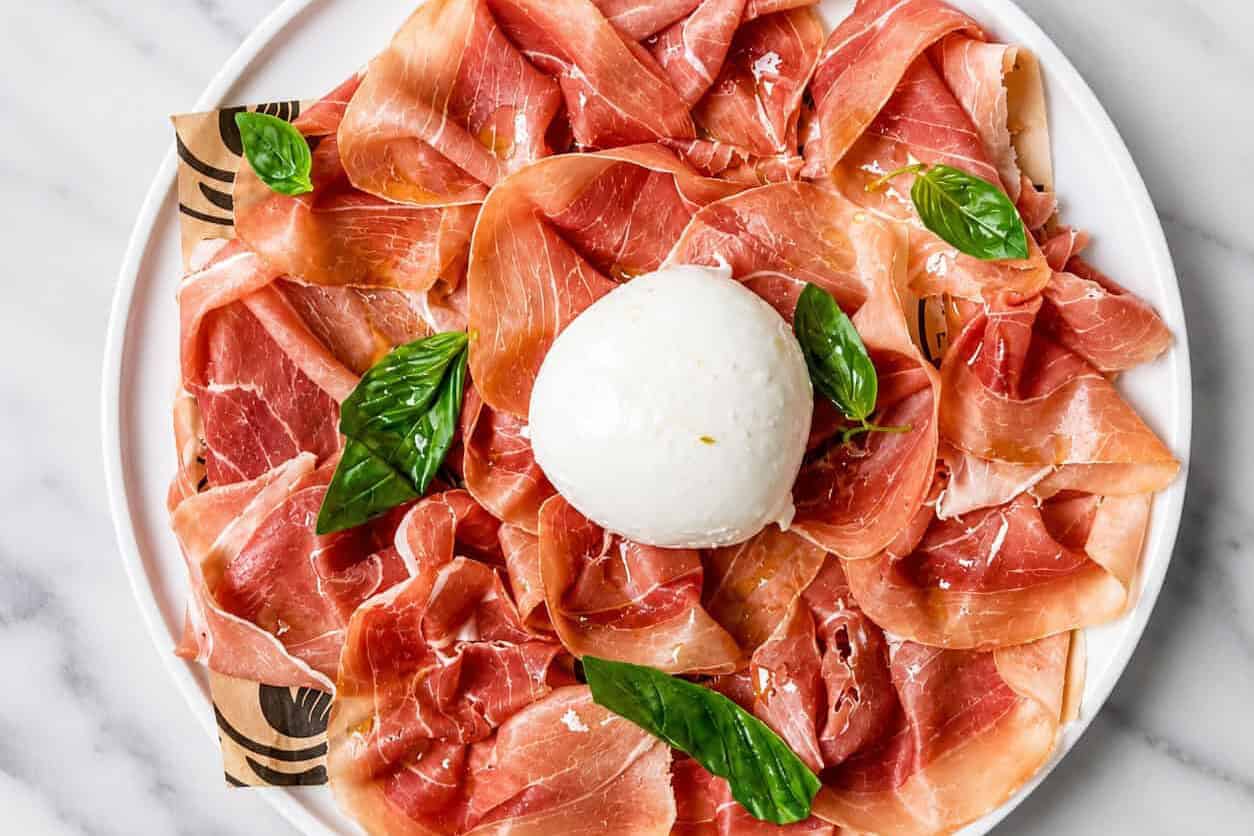
Prosciutto is one of Italy’s most celebrated cured meats — and at Via Napoli Pizzeria, across our two Sydney restaurants in Surry Hills and Lane Cove, Prosciutto di Parma appears on the menu in three distinct forms: laid cold over freshly baked pizzas, folded through a cream pasta sauce, and served as a standalone antipasto with burrata cheese. Few Italian ingredients are more versatile — or more misunderstood.
This guide covers what prosciutto actually is, why Prosciutto di Parma is considered the finest example, how it’s made, and why the way it goes onto Neapolitan pizza is different from almost everything else on the plate.
What Is Prosciutto?
Prosciutto is Italian dry-cured ham made exclusively from the hind leg of the pig, aged without heat using only sea salt, air, and time. The word “prosciutto” translates directly to “ham” in Italian, but in culinary usage it refers specifically to the dry-cured variety — sliced paper-thin, semi-translucent, with a sweet, delicate flavour and a texture that melts on the tongue.
There are two main types. Prosciutto crudo is uncooked and dry-cured — the version most people know. Prosciutto cotto is cooked ham, closer in character to deli ham, and an entirely different product. When a menu lists “prosciutto” without qualification, it almost always means crudo.
Prosciutto di Parma: Italy’s Protected Ham
Prosciutto di Parma is a Protected Designation of Origin (PDO) product, which means it can only be produced in the Parma province of Emilia-Romagna, under rules enforced by the Consorzio del Prosciutto di Parma. No additives, preservatives, hormones, or colouring agents are permitted. The only ingredients are Italian sea salt, air, and time.
This designation is a guarantee of provenance and production method — not just a regional label. Prosciutto produced elsewhere, even in Italy, cannot carry the Parma name or its symbol: a five-point Ducal Crown, fire-branded onto the leg by an independent inspector only after the ham has passed a final quality assessment.
The result is what many producers and restaurants — including Via Napoli Pizzeria, recognised in the Gambero Rosso Top Italian Restaurants 2026 guide — choose when they want the genuine article.
How Prosciutto di Parma Is Made
The production of Prosciutto di Parma is slow and deliberate. After the legs arrive at the prosciuttificio, each one is tagged with a button recording the date curing begins — the clock that determines legality.
A maestro salatore (salt master) applies sea salt by hand, using only what the leg requires. The leg is refrigerated for a week, receives a second thin coating of salt, then rests for another 15 to 18 days. After washing and an initial drying period, the hams hang in large, ventilated rooms where windows are opened to allow Parma air to circulate — a stage considered critical to the development of flavour. By month seven, the hams move to cellar rooms with less light and air, where they continue to age undisturbed.
By law, Prosciutto di Parma must cure for a minimum of 400 days from the date of first salting. Some legs are aged for up to three years. Before the Ducal Crown is branded on, an independent inspector punctures the ham in several locations with a horse bone needle — chosen because it absorbs and releases scent quickly — and checks each puncture for any sign of spoilage. Only hams that pass are certified and released.
Prosciutto Crudo vs Prosciutto Cotto
Prosciutto crudo is dry-cured and uncooked, eaten exactly as it comes in paper-thin slices. It is not “raw” in the way unprocessed meat is; the curing process eliminates bacteria and makes it safe to eat. Prosciutto cotto is cooked ham — baked or steamed — and while it has its uses, it is a different ingredient with a different texture, flavour, and application.
Related cured meats sometimes confused with prosciutto include pancetta (pork belly rather than hind leg, typically used as a cooking ingredient), speck (lightly smoked, from Alto Adige), and culatello (the central part of the hind leg, aged in a bladder casing). Each has a distinct character — but none is prosciutto.
Why Prosciutto Goes onto Neapolitan Pizza After Baking
Prosciutto di Parma is not baked onto Neapolitan pizza — it is placed cold onto the finished pizza after it leaves the oven. At the temperatures involved in cooking a Neapolitan pizza — 450 to 480°C in a wood-fired oven, for 60 to 90 seconds — thin slices of prosciutto would curl, dry out, and lose the delicate fat marbling that gives them their sweetness. The cold placement is deliberate: the residual heat of the crust warms the prosciutto slightly without cooking it.
This technique is consistent with the Associazione Verace Pizza Napoletana (AVPN) tradition, where certain toppings are added post-bake to preserve their character. The effect is a contrast of textures — warm, charred, elastic crust under cool, silky, sweet prosciutto — that wouldn’t survive the oven. The base itself, hand-stretched from dough cold-fermented for 48 hours, is what holds the whole thing together.
Prosciutto at Via Napoli
At Via Napoli Pizzeria, founded by Luigi Esposito — a third-generation pizzaiolo born in Naples — Prosciutto di Parma appears across three sections of the dine-in menu.
As an antipasto, it comes as Parma Prosciutto: thin slices served with burrata cheese and artisan garlic and rosemary focaccia. It’s the simplest possible combination, and one of the most instructive — the sweetness of the cured ham against the cool, fresh cream of the burrata, with the focaccia providing the base. For more on how to start an Italian meal, our guide to what is antipasto covers the full first-course tradition.
Across the pizza menu, Prosciutto di Parma is added cold to three different wood-fired pizzas. The Burratina pairs it with San Marzano tomato, fior di latte, and burrata cheese — the most-requested combination on the menu. The Chiara takes a white base with fior di latte, Prosciutto di Parma, buffalo bocconcini, and black truffle. The Elena 3.0, also on a white base, brings together fior di latte, Prosciutto di Parma, burrata, and honey truffle.
In pasta, prosciutto takes a different form entirely. The Rigatoni Boscaiola uses Prosciutto di Parma crisped rather than served cold — briefly crisped and folded through a creamy mushroom sauce with Grana Padano DOP and pepper. Here it provides saltiness and texture rather than the delicacy it brings to pizza.
Reserve a table at Via Napoli →
Frequently Asked Questions
What does prosciutto mean in Italian?
Prosciutto is the Italian word for ham. It derives from the Latin “perexsuctum,” meaning “thoroughly dried.” In Italian culinary usage, the word most commonly refers to dry-cured ham (prosciutto crudo) made from the hind leg of the pig, though it technically encompasses cooked ham (prosciutto cotto) as well.
How do you pronounce prosciutto?
Prosciutto is pronounced “proh-SHOO-toh.” The “sc” combination in Italian produces a soft “sh” sound — not a hard “sk.” The double “tt” is held slightly longer than a single consonant, and the final “o” is open and clearly sounded. A common mistake is to treat the “c” as a hard consonant; it is not.
Is prosciutto raw?
Prosciutto crudo is not cooked by heat, but it is not raw in the conventional sense. The dry-curing process — sea salt, controlled airflow, and an extended ageing period — eliminates harmful bacteria and makes prosciutto safe to eat without any cooking. Prosciutto cotto is a separate product, cooked during production, closer to what most people would recognise as deli ham.
What is the difference between prosciutto crudo and prosciutto cotto?
Prosciutto crudo is dry-cured, uncooked, and served in thin slices — it is what most people mean when they say “prosciutto.” Prosciutto cotto is cooked ham, produced by baking or steaming rather than curing, with a softer, moister texture closer to traditional deli ham. The two are distinct products with different flavour profiles, textures, and culinary uses.
What is the difference between prosciutto and pancetta?
Prosciutto is made from the pork hind leg and is dry-cured whole, then sliced thin and eaten without cooking. Pancetta is made from pork belly, rolled and cured with salt and spices, and is more often used as a cooking ingredient than served raw. Though both are Italian cured meats, they have different fat ratios, textures, and typical applications in the kitchen.
Why is prosciutto added to pizza after baking, not before?
Prosciutto di Parma is placed cold onto the pizza after it leaves the oven to preserve its texture and flavour. Neapolitan pizzas cook at 450 to 480°C for 60 to 90 seconds — temperatures at which thin slices of prosciutto would curl, dry out, and lose the fat marbling responsible for their sweetness. Placing prosciutto on the hot pizza immediately after baking allows the residual heat to warm it gently without cooking it.
How long is Prosciutto di Parma aged?
By law, Prosciutto di Parma must be cured for a minimum of 400 days from the date of first salting. Some legs are aged for up to three years, developing a deeper, more complex flavour. This extended curing period — combined with the requirement that production occur only in Parma, Italy, using sea salt, air, and time as the only ingredients — is the foundation of the Prosciutto di Parma PDO designation.