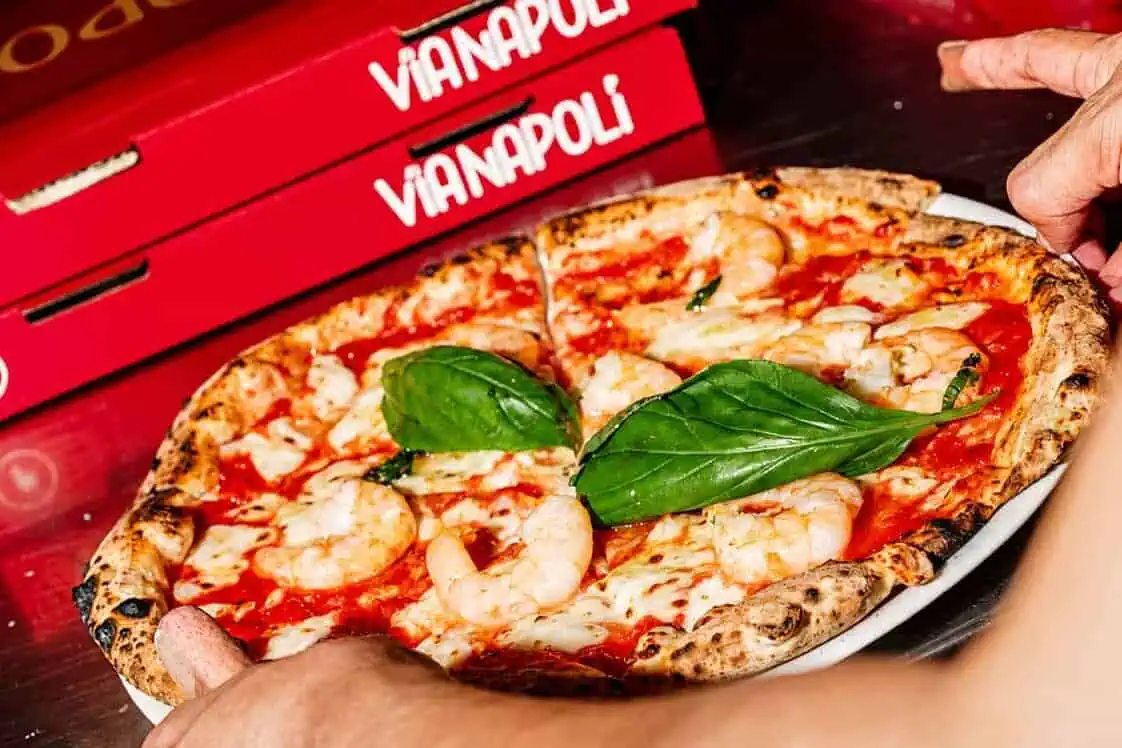
Neapolitan pizza isn’t just another style on the menu. It’s a centuries-old craft, a protected tradition, and — if you’ve ever had the real thing — an experience that makes every other pizza feel like a rough draft.
At Via Napoli Pizzeria, we make it the way it was always meant to be made: hand-stretched dough, premium Italian ingredients, and wood-fired ovens burning the way they have in Naples for generations. Here’s what actually sets it apart.
A Pizza Born in Naples
The story starts in 18th-century Naples, where pizza began not as a restaurant dish but as street food — fast, cheap, and built from whatever was close at hand. Flour, tomatoes, mozzarella, olive oil, basil. That was it.
What started as a working-class meal became one of the most imitated foods on the planet. Today, authentic Neapolitan pizza is formally protected by the Associazione Verace Pizza Napoletana (AVPN), which sets precise standards for how it must be made — the dough, the oven, the ingredients, all of it.
👉 Learn more about our Italian heritage and pizza philosophy
The Dough: Where Everything Starts
Ask any Neapolitan pizzaiolo what makes the difference and they’ll tell you the same thing: it’s the dough.
Four ingredients — flour, water, salt, yeast — and time. Neapolitan dough is naturally fermented, never rushed, and always hand-stretched. No rolling pins, no shortcuts. The fermentation does something that faster methods can’t: it develops flavour from the inside out, and it makes the dough genuinely easier on your stomach.
The result is a thin base with a puffy, blistered edge called the cornicione. Tender and slightly chewy, with a flavour that holds its own even before the toppings go on. It’s nothing like the dry, cardboard-crisp bases that pass for pizza in a lot of places.
The Ingredients: Less, and Better
Neapolitan pizza operates on a simple principle: if every ingredient is exceptional, you don’t need many of them.
The classics — San Marzano tomatoes, fior di latte or buffalo mozzarella, extra virgin olive oil, fresh basil — aren’t just tradition for tradition’s sake. They’re chosen because they genuinely taste better. San Marzano tomatoes are sweeter and less acidic than most varieties. Buffalo mozzarella has a richness that pre-shredded supermarket cheese can’t touch.
There’s no cheese avalanche. No sauce drowning the base. Just a few things doing exactly what they’re supposed to do.
👉 Explore our authentic Italian menu
The Wood-Fired Oven: 90 Seconds of Intense Heat
This is the part that surprises most people. Authentic Neapolitan pizza cooks at 450–500°C and is done in 60 to 90 seconds. That’s not a typo.
At that temperature, something specific happens: the outside sets fast, trapping moisture inside. The crust chars in spots — those dark leopard-print blisters you see on a proper Neapolitan base — while the centre stays soft and almost pillowy. A conventional oven running at 250°C simply can’t replicate it. The pizza either dries out or it doesn’t develop the right texture at all.
Wood fire adds one more thing: a faint smokiness that you can’t manufacture any other way. It’s subtle, but it’s there.
The Texture: Soft, Foldable, a Little Surprising
If you’re expecting something crisp and rigid, Neapolitan pizza will catch you off guard — in the best way.
The base is soft in the middle and yields when you fold it, which is exactly how it’s eaten in Naples. You pick it up, you fold it in half, you eat it. No knife and fork required, though you’re welcome to use them. The edges are airy and charred at the tips, with just enough structure to hold everything together without being bready or dense.
First-timers often comment that it feels lighter than what they’re used to. That’s not an accident.
Traditional Pizzas Worth Starting With
If it’s your first time with a proper Neapolitan pizza, don’t overthink it. Start with the classics.
Margherita — tomato, mozzarella, basil, olive oil. Iconic for good reason. There’s nowhere to hide on a Margherita, which means every component has to earn its place.
Diavola — tomato, mozzarella, spicy salami. A little heat, a little attitude. Still restrained by most pizza standards, but with a bolder character.
These two pizzas show what Neapolitan-style cooking does best: quality over quantity, every time.
👉 See our full pizza selection
Why It Feels Lighter Than Other Pizza
A lot of people finish a Neapolitan pizza and notice they don’t feel like they’ve been hit by a truck. That’s down to a few things working together.
The natural fermentation breaks down the dough in a way that makes it easier to digest. The toppings are restrained — no excess oil pooling in the middle, no aggressive cheese load. And the fast cook time means nothing is sitting in heat long enough to become greasy or heavy. It’s indulgent, but it’s balanced. You can comfortably eat a whole pizza and still want dessert.
The Italian Way to Eat Pizza
In Naples, pizza is social currency. You don’t eat it on the way somewhere — you sit down, you order wine or a cold Peroni, and you take your time. It’s a meal that belongs to the table, not the counter.
That philosophy carries through to how we do things at Via Napoli. Whether you’re in for a midweek dinner or a long table with the whole family, the pizza is designed to be shared, savoured, and eaten hot — the way it was always intended.
👉 Book a table for your next Italian night out
Great for Groups, Events and Celebrations
Neapolitan pizza is made for sharing, which makes it a natural fit for everything from casual birthdays to corporate lunches. The format scales well — generous individual pizzas, set menus that work for groups, and a kitchen built to handle volume without cutting corners.
Via Napoli handles functions and private dining at both locations, along with Italian catering and mobile wood-fired oven hire for events further afield.
👉 Discover our group dining and function menus
👉 Explore Italian catering options
Experience Authentic Neapolitan Pizza at Via Napoli
Every pizza that comes out of our ovens is made the traditional way — hand-stretched dough, ingredients sourced for flavour rather than convenience, and the kind of wood-fired heat that can’t be cheated.
Whether you’re dining in at Surry Hills or Lane Cove, ordering takeaway, or planning something bigger, the pizza is the same: honest, flavourful, and as close to Naples as you’ll find in Sydney.
👉 Find your nearest Via Napoli location
Ready to Taste the Difference?
Explore the Via Napoli menu and find out why Neapolitan pizza has been making people happy for the better part of three centuries.
Frequently Asked Questions
Neapolitan pizza is defined by naturally fermented dough, minimal toppings and extremely fast cooking in a wood-fired oven at very high temperatures. This creates a soft, airy crust with light charring and a balanced, delicate flavour you won’t get from a conventional oven.
Yes. Authentic Neapolitan pizza must be cooked in a wood-fired oven reaching around 450–500°C. That intense heat is essential — it’s what produces the right texture, the blistered crust and the faint smokiness that defines the style.
Neapolitan pizza is intentionally soft and foldable, not crisp or crunchy. The dough’s hydration, natural fermentation process and rapid cooking time all work together to create a tender centre with a light, airy crust — the cornicione — that’s distinctive to the Neapolitan style.
Classic Neapolitan pizza uses a small number of high-quality ingredients: San Marzano tomatoes, fior di latte or buffalo mozzarella, extra virgin olive oil and fresh basil. The philosophy is balance rather than abundance — each ingredient is chosen to complement, not compete.
Many people find it so. The dough is naturally fermented, which breaks it down before it’s even cooked. Combined with minimal toppings and a quick cook time that keeps the base from becoming dense or oily, it tends to sit more comfortably than heavier pizza styles.
The two most traditional styles are the Margherita — tomato, mozzarella, basil and olive oil — and the Marinara, which uses tomato, garlic, oregano and olive oil. Both showcase the simplicity and restraint that define authentic Neapolitan pizza at its best.
Neapolitan pizza is recognised as a cultural tradition in Italy, with the AVPN setting strict guidelines for how it must be made. Those standards exist to preserve the original techniques, ingredients and cooking methods that have been passed down through generations — and to ensure that what calls itself Neapolitan actually is.
Traditionally, Neapolitan pizza is eaten fresh from the oven — often folded slightly — and enjoyed immediately while hot. It’s a social food, designed for the table rather than the takeaway box, and best shared with good company and something cold to drink.
Traditional Neapolitan pizza uses wheat flour, but many modern pizzerias — including Via Napoli — offer gluten-free alternatives. The texture differs slightly from the original, but the goal is always to get as close to the authentic experience as possible.